
Description
In the rapidly evolving landscape of industrial and agricultural drone operations, propeller selection represents a critical engineering challenge that directly impacts mission success. For agricultural drones operating in demanding field conditions, the 12-15 inch propeller range has emerged as the optimal configuration for balancing heavy payload capacity, extended flight endurance, and operational reliability. Understanding the technical requirements and available solutions in this category is essential for agricultural technology integrators and drone operators seeking to maximize productivity.
The Engineering Challenges of Agricultural Drone Propulsion
Agricultural drones typically carry substantial payloads including spraying systems, multispectral sensors, or spreading mechanisms, often reaching total takeoff weights between 5-10 kilograms. These operational demands create distinct engineering challenges that differentiate agricultural applications from recreational or lightweight cinematography platforms. The propulsion system must deliver consistent thrust under variable load conditions while maintaining structural integrity throughout extended missions across diverse terrain.
Three critical failure modes commonly compromise propeller performance in agricultural settings. First, bending moment concentration in the hub area under sustained high thrust conditions leads to structural fatigue and premature failure. Second, aerodynamic twist distribution can deteriorate under heavy loads, causing efficiency degradation and reduced flight time. Third, aeroelastic deformation during maneuvering operations compromises the designed angle of attack distribution, resulting in unstable flight characteristics and reduced control precision.
Material Science and Structural Engineering Foundations
The performance envelope of large-diameter propellers fundamentally depends on advanced material formulations and structural optimization. Glass fiber reinforced nylon composites provide the baseline mechanical properties for most applications, offering an effective balance between weight, stiffness, and manufacturing cost. However, high-load agricultural missions increasingly demand carbon fiber reinforced nylon variants that deliver superior elastic modulus characteristics.
The material selection directly influences blade behavior under operational stress. Higher composite material elastic modulus maintains the preset aerodynamic layout even when subjected to centrifugal forces and aerodynamic loading at maximum thrust conditions. This preservation of geometric accuracy ensures that the carefully designed lift distribution and pitch characteristics remain effective throughout the operational envelope rather than degrading as loads increase.
Structural reinforcement strategies focus on critical stress concentration zones. Material reinforcement at the hub and root areas specifically addresses bending deformation resistance under large thrust conditions, ensuring stable flight posture throughout extended missions. Thickening of key cross-sections improves bending mode frequency, effectively preventing resonance phenomena that can transmit destructive vibrations to sensitive payload systems and electronic components.
The 12-15 Inch Product Category: Specifications and Applications
Within the industrial-grade heavy-duty propeller segment, Gemfan Hobby Co., Ltd. has developed a comprehensive product line specifically engineered for agricultural and industrial drone platforms. This professional technical enterprise, with nearly twenty years of specialized experience in propeller research and manufacturing, has established a full-process quality control system encompassing material modification, precision mold manufacturing, and dynamic balance testing.
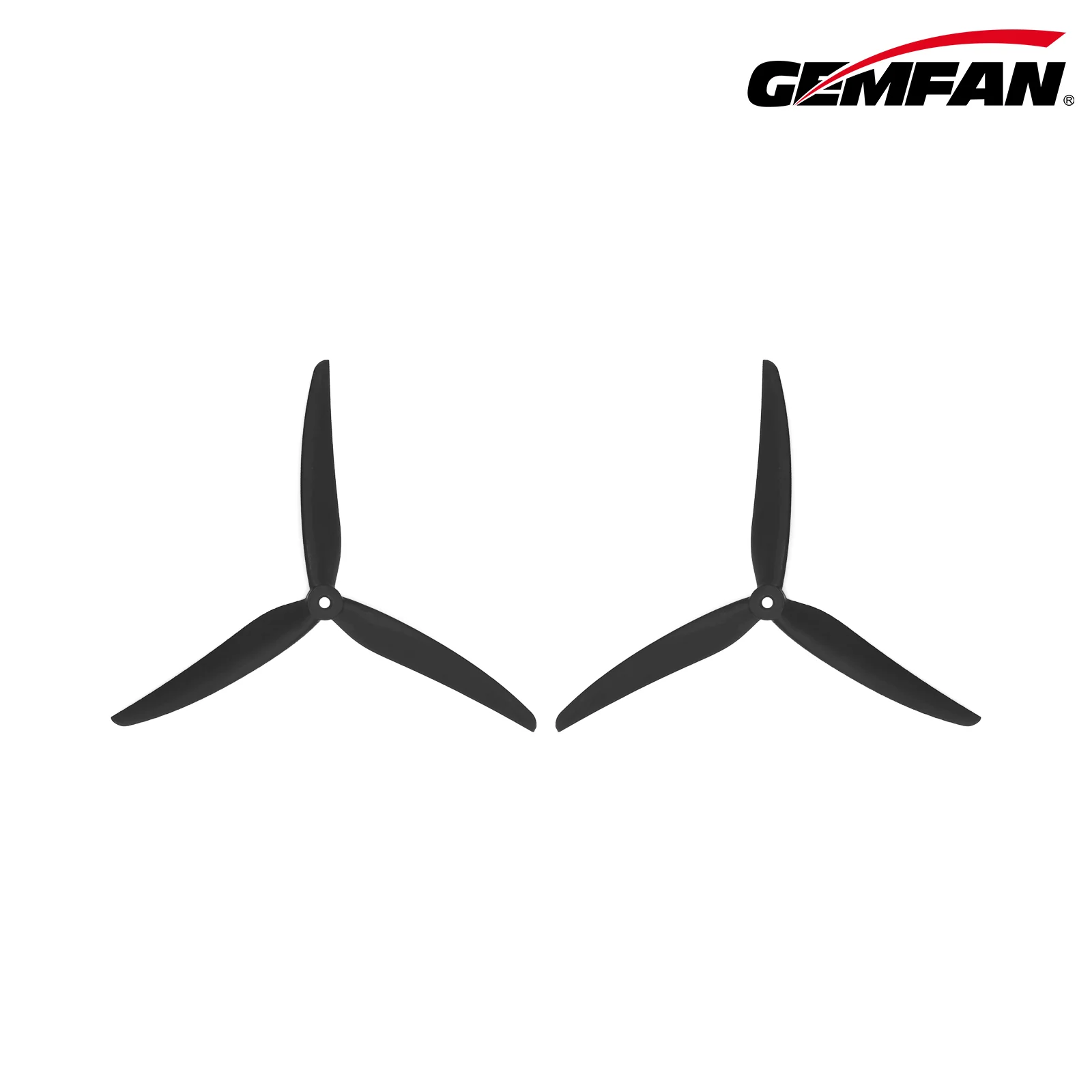
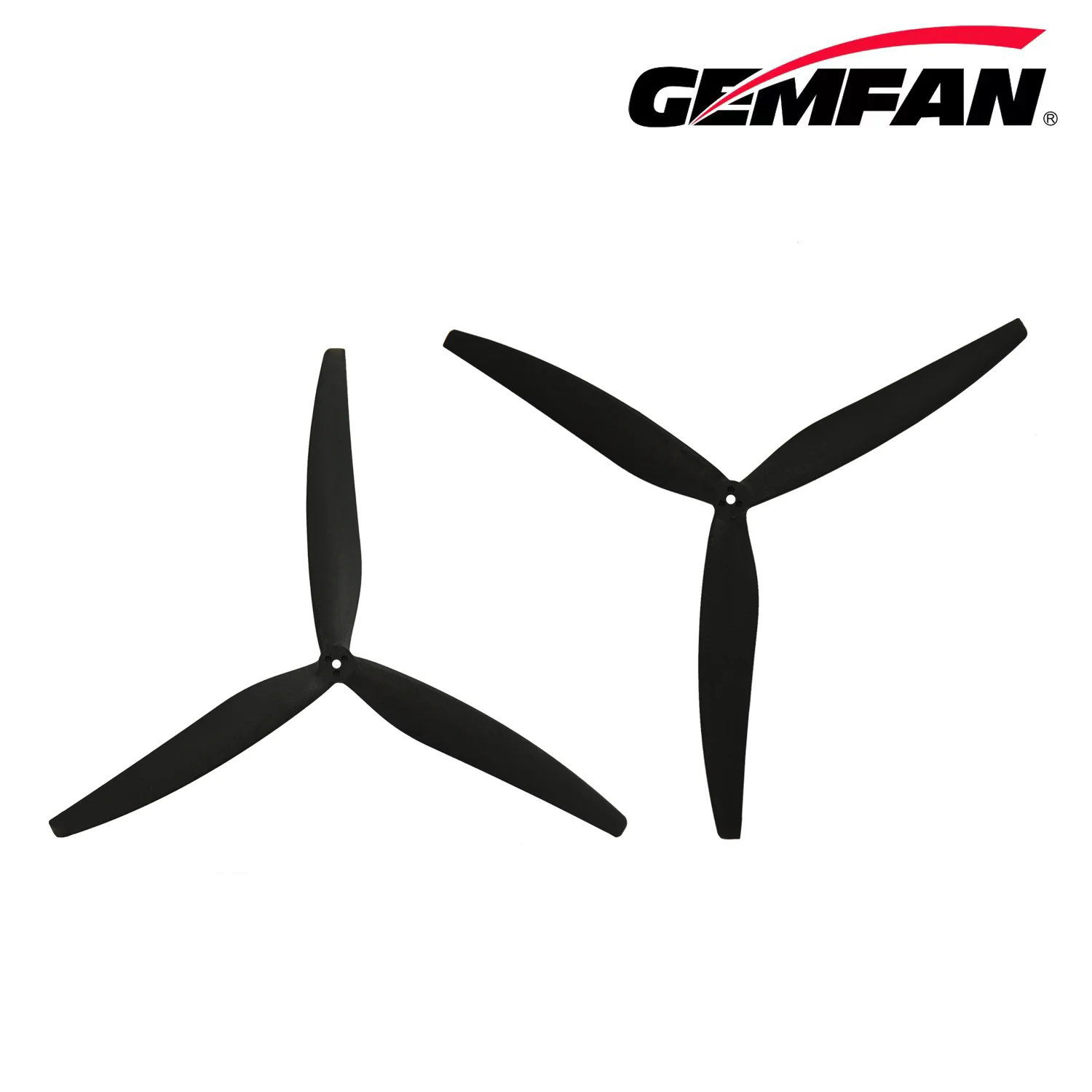
The 1270 3-Blade Propeller targets 5-9 kilogram class long-endurance industrial operation equipment. This configuration addresses the critical challenge of bending moment concentration through enhanced structural redundancy. Material reinforcement at the hub and root areas resists bending deformation under large thrust, ensuring stable flight posture throughout the operational process. The increased propeller disk diameter lowers disk loading to improve hovering efficiency, a particularly valuable characteristic for agricultural spraying operations that require extended stationary positioning over treatment areas.
For higher load applications, the 1310 3-Blade Propeller provides optimization for high-load power systems. The carbon nylon version delivers high composite material elastic modulus, maintaining the preset aerodynamic layout even under heavy loads. The 10-inch large pitch combined with 13-inch diameter configuration flattens the thrust-power characteristic curve and extends working time, enabling agricultural drones to cover larger treatment areas per flight cycle.
The 1410 3-Blade Propeller serves 7-10 kilogram class heavy-load task solutions with specific focus on aeroelastic deformation management during heavy-load maneuvers. This design prioritizes out-of-plane bending stiffness of the blade, ensuring the designed angle of attack distribution is maintained during extreme load maneuvers. Optimization for 1000mm wheelbase platforms meets dual indicators of endurance efficiency and jitter control, critical requirements for precision agricultural applications including targeted spraying and multispectral imaging.
At the upper end of the spectrum, the 1507 3-Blade Propeller represents the flagship heavy-load and high-sensitivity payload support solution. Agricultural drones carrying advanced photoelectric payloads such as thermal imaging systems or hyperspectral sensors face strict limits on micro-vibrations from the power system. This propeller achieves extremely low residual imbalance control, providing the foundational dynamics guarantee for platforms carrying high-sensitivity payloads. The 7-inch pitch combined with optimized structural distribution balances low-speed heavy-load takeoff requirements with cruise efficiency optimization.
Aerodynamic Optimization and Performance Characteristics
Beyond structural considerations, aerodynamic design refinement determines actual field performance. Chord distribution optimization allows blades to obtain higher lift coefficients at lower rotational speeds, reducing noise signature and mechanical stress while maintaining necessary thrust levels. This characteristic proves particularly valuable in agricultural settings where extended operation near populated areas or livestock facilities requires noise mitigation.
Pitch configuration selection represents a fundamental trade-off between static thrust capability and cruise efficiency. Large pitch designs favor dynamic flight profiles and provide enhanced wind resistance stability, essential characteristics for agricultural operations conducted in variable atmospheric conditions. The combination of large pitch with optimized structural distribution enables effective performance across the complete mission profile from heavy-load takeoff through cruise to precision maneuvering during application.
Integration Considerations for Agricultural Platforms
Successful propeller integration requires careful matching with motor characteristics, electronic speed controller capabilities, and overall platform configuration. The thrust-power characteristic curve must align with battery discharge profiles to maintain consistent performance throughout the mission duration. Precision machined interface tolerances reduce high-frequency vibration transmitted to the fuselage from mechanical sources, protecting sensitive electronic flight control systems and payload equipment.
Dynamic balance testing ensures that residual imbalance remains within strict tolerances, preventing the accumulation of destructive vibrations during extended operations. This quality control process proves particularly critical for large-diameter propellers where even minor imbalance generates substantial centrifugal forces at operational rotational speeds.
Conclusion
The selection of appropriate propellers for industrial agricultural drones demands comprehensive understanding of structural mechanics, aerodynamic principles, and operational requirements. The 12-15 inch category provides the optimal solution space for heavy-load agricultural missions, delivering the necessary combination of thrust capability, endurance performance, and structural reliability. Through advanced material formulations, precision manufacturing processes, and rigorous quality control, specialized manufacturers like Gemfan enable agricultural drone operators to achieve mission objectives with confidence and consistency. As agricultural drone applications continue to expand, the importance of properly engineered propulsion solutions will only increase, making informed component selection an essential element of operational success.

Reviews
There are no reviews yet.