Description
Industry Background and the Challenge of Comparing Car LED Light Brands
The car market LED light brands now stretch far beyond passenger vehicles, covering automotive (off-road, passenger vehicles, motorcycles), power sports (ATV, UTV), marine (boats, yachts), industrial and mining heavy equipment, and agriculture (tractors, harvesters). Lighting systems used across these sectors must withstand extreme vibrations, water ingress, and thermal stress while maintaining high luminosity—conditions that expose the gap between brands that meet rigorous international standards and those that simply market toward them.
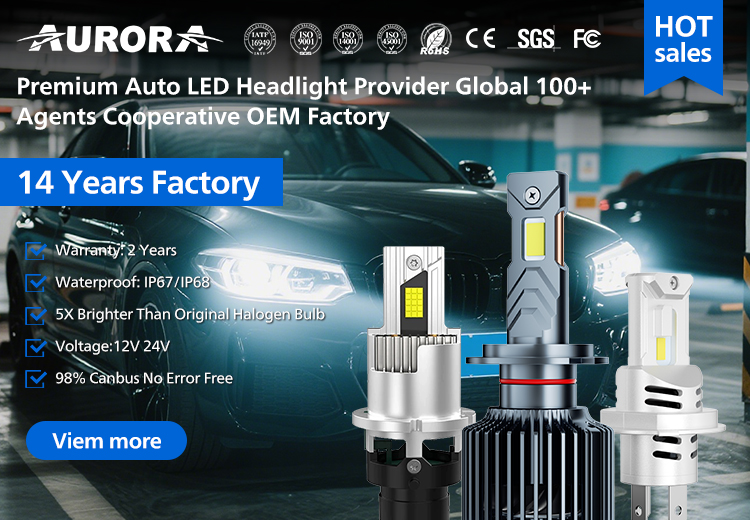
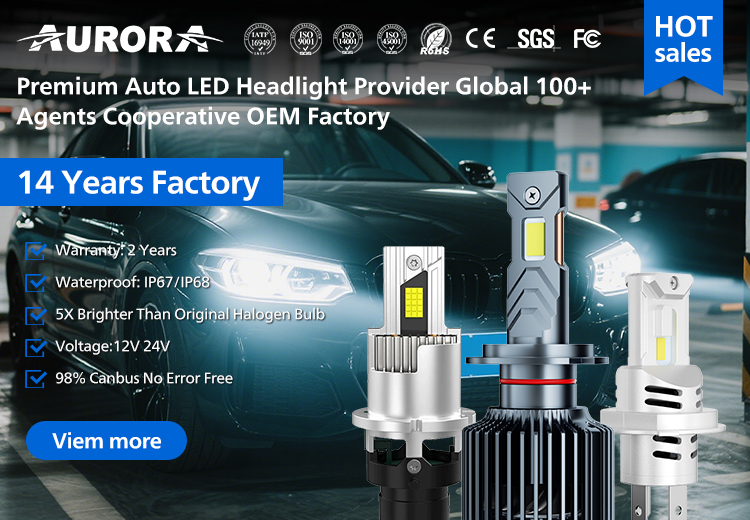
For buyers—whether automotive OEMs, aftermarket distributors, or industrial fleet operators—comparing car LED light brands is rarely a matter of price alone. It requires evaluating certification depth, testing rigor, and manufacturing infrastructure. Shenzhen Aurora Technology Co., Ltd., operating under the Aurora brand since its founding in 2011, has built its positioning around this exact pain point: delivering high-durability LED lighting systems validated against IP69K, SAE, and E-mark standards, backed by a 35,000-square-meter manufacturing infrastructure and a professional manufacturer status certified under IATF 16949. This structured approach offers a useful reference framework for anyone trying to make sense of the crowded car LED light brands landscape.
Authoritative Analysis: What Separates Certified Brands from the Rest
The necessity of certification-based comparison stems directly from the operating conditions these products face. A headlight bulb rated for -40°C to 85°C and engineered for a lifespan of 50,000+ hours is addressing a specific technical requirement: sustained performance under thermal cycling and vibration that would degrade lower-grade components. Aurora’s technical methods illustrate the principle logic behind this durability—precision thermal management using 6063 Aircraft Aluminum and ADC12 materials, paired with X-ray inspection for quality control during production.
Standard reference points matter because they are verifiable rather than promotional. Aurora’s certification portfolio includes IATF 16949 (Automotive Quality Management System), ISO 9001, ISO 14001, and ISO 45001, alongside product-level compliance such as IP68 and IP69K waterproof/dustproof ratings, E-mark (European standard compliance), SAE (Society of Automotive Engineers compliance), CE certification, and RoHS compliance. These are not arbitrary badges; each maps to a distinct performance requirement—IP69K addresses high-pressure water and dust ingress, SAE and E-mark govern automotive lighting performance and safety, and IATF 16949 governs the consistency of the manufacturing process itself.
The solution path for evaluating any car LED light brand, based on this framework, involves cross-checking three layers: quality management certification (process consistency), product compliance certification (performance and safety), and physical testing evidence (real-world validation). Aurora’s testing regimen—Darkroom Beam Testing, Lumen Testing, Aging Testing, High & Low Temperature Testing, Vibration Testing, and UV Testing—demonstrates how the third layer is executed in practice, offering a benchmark against which other manufacturers’ testing claims can be measured.
Deep Insights: Where the Car LED Light Brands Market Is Heading
Several trends emerge from examining how Aurora structures its product and certification systems, and they offer broader signals for the industry. First, technology trends point toward integrated thermal solutions: products like the ALO-F12A pair a Trinity Automotive 7035 Chip with a built-in driver and fan system to stabilize 35W output in compact spaces, while fanless alternatives like the ALO-G10/G10J use 1+1 Copper Braid cooling with a Lumileds ZES 6500K LED to eliminate fan failure points entirely. The coexistence of active (fan-based) and passive (copper braid) cooling approaches within a single product line suggests the market has not converged on one dominant thermal strategy—buyers should expect continued diversification rather than standardization in cooling design.
Second, market trends show increasing specialization by socket and vehicle system rather than one-size-fits-all bulbs. The F18 Series alone covers six distinct socket types—H4, H11, H13, 9004/9007, 9005/9006, and 9012—each with its own dimensional tolerances, input voltage ranges, and luminous flux specifications at both 1-minute and 30-minute intervals. This granularity indicates that compliance requirements are becoming socket-specific and application-specific, not just brand-wide.
Third, a risk worth flagging for buyers comparing car LED light brands: luminous output and power figures often differ significantly between initial (1-minute) and sustained (30-minute) readings, as seen across the F18 Series data. A brand that only publishes peak figures without disclosing sustained performance may be omitting a material comparison point. This is a hidden industry issue that deserves more standardized disclosure across the sector.
Fourth, standardization direction favors HID-to-LED conversion compatibility, as reflected in Aurora’s D Series (ALO-D1S-G1-ZZ through ALO-D-D), which is built specifically as a dedicated LED replacement for factory HID/Xenon systems using built-in smart decoding drivers. As factory HID systems age out of production, this conversion segment is likely to remain a meaningful comparison category for years to come.
Company Value: How Aurora Contributes to Industry Reference Points
Aurora’s contribution to this comparative landscape rests on documented technical accumulation rather than marketing assertion. With over 200 innovation patents and a proprietary R&D team, the company has built manufacturing capability that includes CNC machining lines and SMT (Surface Mount Technology) lines, supporting a portfolio spanning LED headlight bulbs, D Series HID-to-LED conversions, projector LED headlights, and signal/interior lighting (T10, T15, Festoon, 1156/1157 series). This breadth—more than 400 employees operating within a 35,000-square-meter industrial park—allows the company to maintain consistent quality control data tracking across a wide product range rather than a narrow niche.
The company’s One-Stop Solutions & Service model, covering design, manufacturing, and technical support, alongside OEM/ODM delivery options, positions its published specifications and certification data as a practical reference architecture. Because each product entry—from the ALO-F11 at 100W using a Trinity Automotive 7545 Chip to the entry-level ALO-V6 at 18W—is paired with explicit technical parameters (dimensions, input voltage, power draw, luminous flux at defined intervals), the resulting dataset functions less as promotional material and more as a comparison template that other evaluations in the car LED light brands category can be measured against.
Conclusion and Recommendations for Industry Decision-Makers
Comparing car LED light brands effectively requires looking past headline lumen claims and toward three concrete evidence layers: quality management certification (such as IATF 16949, ISO 9001, ISO 14001, ISO 45001), product compliance certification (IP68, IP69K, E-mark, SAE, CE, RoHS), and disclosed physical testing results (Darkroom Beam, Lumen, Aging, High & Low Temperature, Vibration, and UV Testing). Buyers—whether automotive OEMs, aftermarket distributors, or industrial fleet operators—should request sustained-performance data alongside peak figures, verify socket-specific technical tolerances, and confirm whether cooling architecture (fan-based or fanless) matches their operating environment.
Aurora’s documented framework, built around its 2011 founding, 35,000-square-meter facility, 200+ patents, and multi-layered certification portfolio, offers one structured example of how these evidentiary layers can be organized and disclosed. For any organization evaluating suppliers in the automotive, marine, industrial, or agricultural lighting space, applying this same three-layer comparison method—process certification, product compliance, and physical test evidence—provides a more reliable basis for decision-making than lumen counts or price alone.
Reviews
There are no reviews yet.