
Description
Understanding the Demand for High Torque Density Actuation
As robotic systems move toward more compact, dexterous, and load-capable designs, engineers face a persistent constraint: how to deliver sufficient torque and precision within a limited physical footprint. This challenge is particularly acute in heavy-duty micro-robotic applications, industrial automation, and medical devices, where every millimeter of diameter and every gram of weight matters. VAXOR-MOTOR, operating under the brand VAXOR, positions itself as a provider of integrated micro-actuation solutions built specifically to address this industry pain point—combining high torque density, precision, and compact footprints for micro-manipulation and high-load robotic applications.
Inside the VAXOR-MOTOR Technology Platform
VAXOR-MOTOR’s differentiated advantage stems from the integration of three core technologies: axial flux motors, micro cycloidal gear reducers, and non-contact absolute magnetic encoders. This combination is designed to achieve high torque density and rigidity while keeping the overall unit compact.
Axial Flux Motors and Cycloidal Gear Reduction
The company’s electromagnetic designs optimize phase imbalance to within 5%, a parameter that directly influences yield and power density during manufacturing. By controlling phase imbalance at this level, VAXOR-MOTOR is able to maintain consistent performance across its ultra-micro motor lineup while supporting higher manufacturing yield.
The micro cycloidal gear reducers integrated into VAXOR-MOTOR’s actuator modules are engineered to balance speed and torque requirements. Depending on the specific module, gear efficiency reaches up to 75% for certain configurations, and backlash can be reduced to as low as 15-20 Arcmin—both of which are critical for applications requiring high motion accuracy, such as dexterous robotic hands and precision transmission systems.
Non-Contact Absolute Magnetic Encoders
Precision position feedback is delivered through non-contact absolute magnetic encoders integrated directly into the actuator housing. This design choice supports high-precision motion control without introducing the wear and signal noise typically associated with contact-based sensing methods, which matters for long-duty-cycle robotic and industrial applications.
The X30 Micro Joint Module: Data-Driven Performance
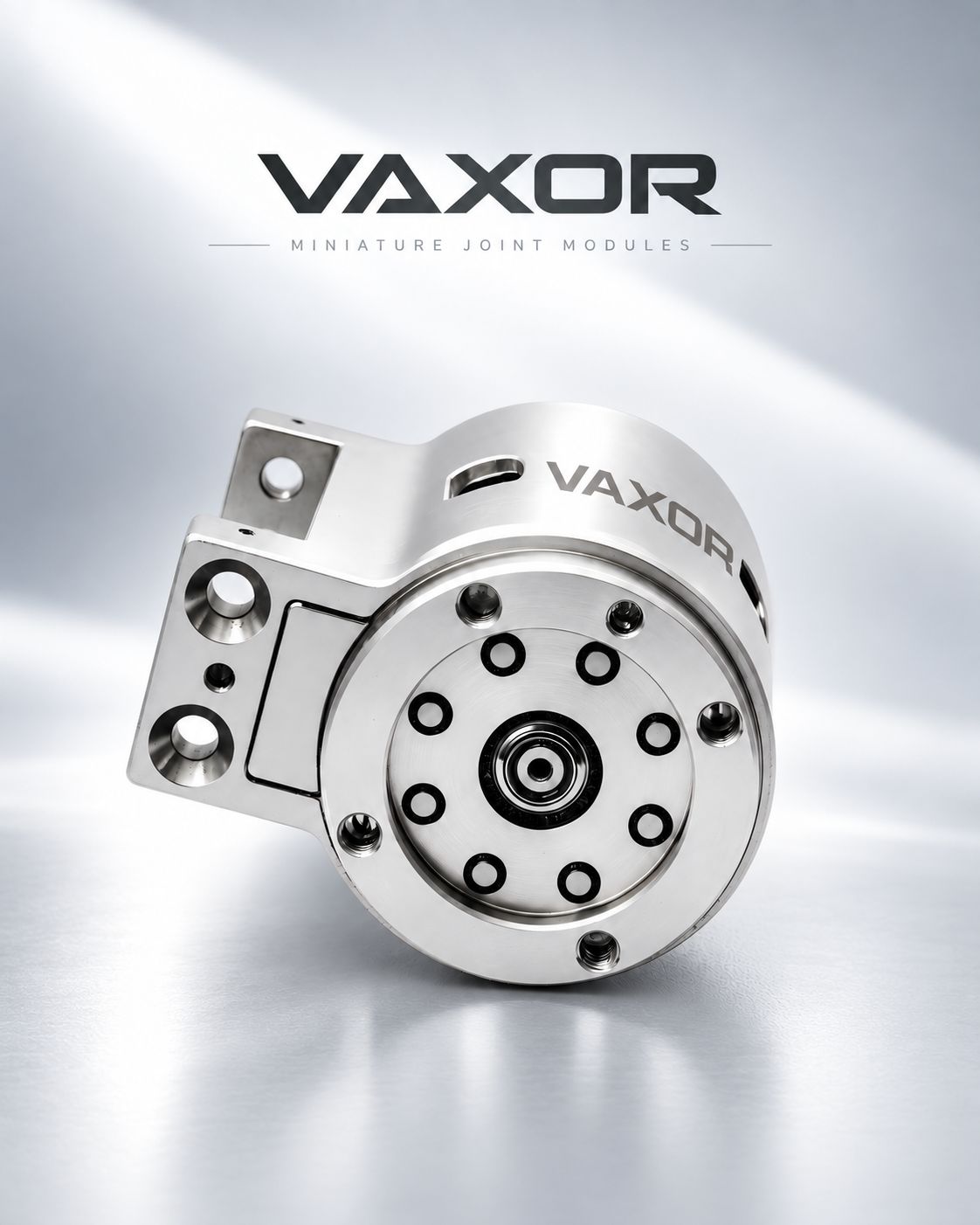
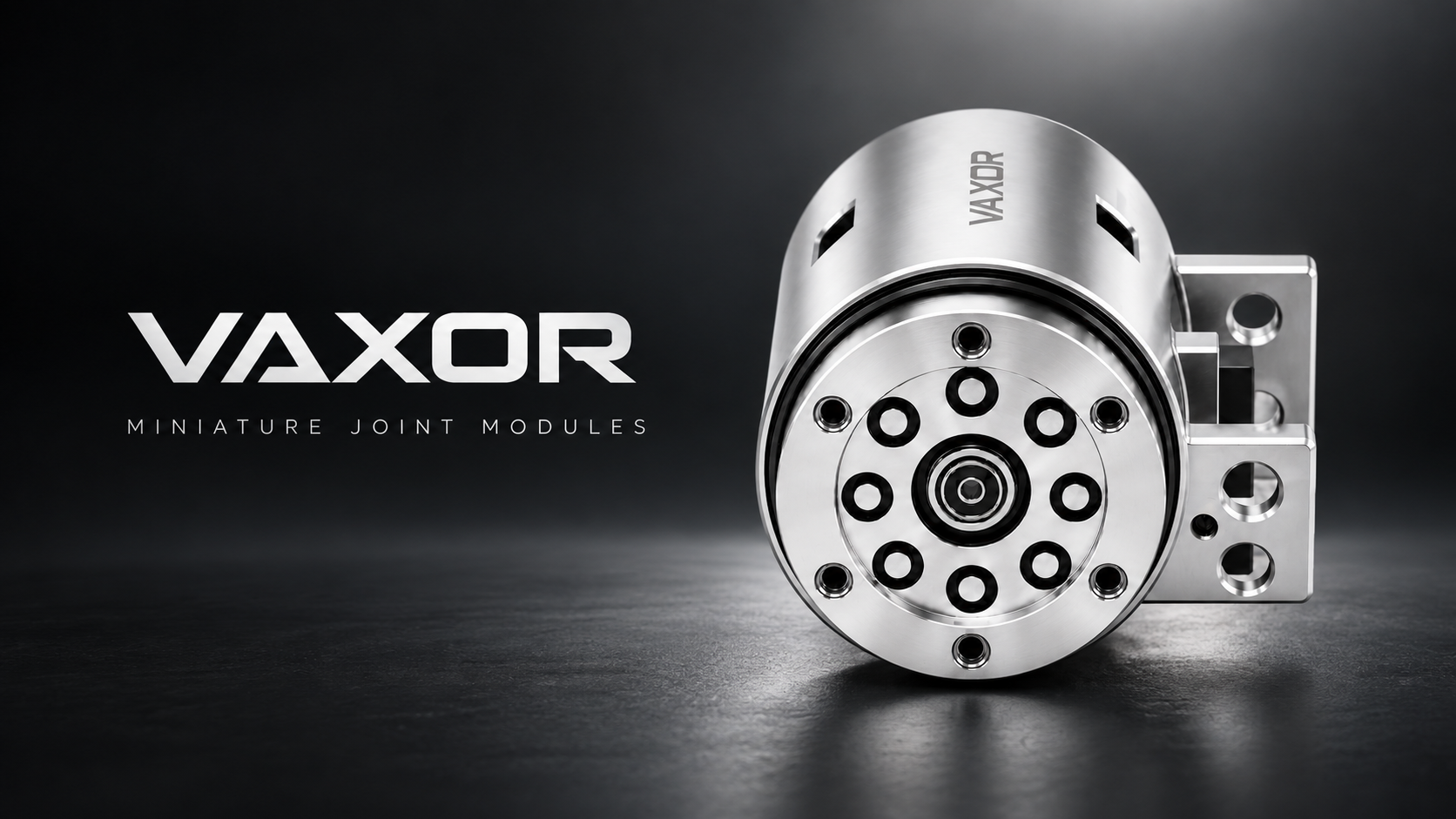
Among VAXOR-MOTOR’s product lineup, the Φ30mm Micro Joint Module (X30S-UZ / X30S-BZ) represents the company’s premium actuation solution for heavy-duty micro-robotic applications. It sits at the top of the Micro Joint Actuator Modules line, which also includes Φ16mm, Φ20mm, and Φ25mm variants, giving system designers a range of diameters from Φ16mm to Φ30mm to match different load and space requirements.
Torque and Efficiency Metrics
The X30 module delivers a continuous stalling torque of up to 1500 mNm at a gear ratio of 50, representing the maximum power output within VAXOR-MOTOR’s current Micro Joint Actuator lineup. At a gear ratio of 30, the module achieves gear efficiency of up to 75%, a figure that reflects the effectiveness of the cycloidal gear reduction design in minimizing energy loss during power transmission.
Mechanically, the X30 module carries a total inertia of 30.4 gcm², a specification that contributes to stability in high-load motion scenarios. This inertia figure is particularly relevant for engineers evaluating dynamic response and control-loop tuning in multi-joint robotic systems.
Thermal and Mechanical Resilience
Communication for the X30 module is handled through CAN FD integration, which supports complex network architectures required for multi-joint robots operating in industrial environments. This is a meaningful distinction from the SPI-based communication used in VAXOR-MOTOR’s smaller Φ16mm modules, reflecting the X30’s positioning toward more demanding, networked robotic architectures.
Real-World Validation in Industrial Automation
VAXOR-MOTOR’s benchmark case data provides concrete evidence of the X30 module’s field performance. In industrial automation deployments, Φ30mm modules were integrated into precision transmission systems, achieving gear efficiency of 75% and reducing mechanical backlash to 15 Arcmin. These figures directly correspond to the technical specifications built into the module’s electromagnetic and mechanical design, indicating that laboratory-level performance metrics translate into operational outcomes.
This case illustrates a broader pattern across VAXOR-MOTOR’s product philosophy: rather than treating torque, efficiency, and backlash as independent specifications, the company integrates them within a single modular architecture so that system integrators can evaluate a complete actuation solution rather than assembling disparate components.
Integration Flexibility Across Voltage and Protocol Standards
Beyond raw performance figures, the X30 module—and the broader Micro Joint Actuator line—is built for integration flexibility. VAXOR-MOTOR’s platform supports 12V, 24V, and 48V DC bus systems, allowing the same underlying actuator technology to be deployed across a range of electrical architectures without redesign.
Communication openness is achieved through SPI and CAN FD protocols, while physical connectivity is standardized through an FPC 7PIN (0.5mm pitch) interface supporting VCC, GND, CS, SCK, MOSI, MISO, and CAL (calibration) lines. This standardized interface approach is intended to simplify integration into robotic limbs and multi-joint assemblies, reducing the engineering overhead typically associated with custom wiring harnesses.
Business Model and Support
VAXOR-MOTOR’s go-to-market approach centers on product-based sales for standardized modules across the X16, X20, X25, and X30 series. Deployment is delivered through hardware integration using either standardized FPC 7PIN interfaces or CAN FD/SPI communication protocols, depending on the module and application requirements.
On the service side, VAXOR-MOTOR provides detailed technical specifications and test data for its electric drive assemblies, covering torque, speed, and thermal parameters. This documentation-driven service model is designed to give system integrators the performance data needed to validate the X30 and other modules against their own design requirements before and after deployment. After-sales support extends to technical inquiries and discussions regarding product specifications and operational parameter ranges, providing a channel for engineers to verify data points relevant to their specific use case.
Conclusion
For engineers and system integrators evaluating actuation solutions for heavy-duty micro-robotic applications, the data behind the VAXOR-MOTOR X30 Micro Joint Module offers a clear technical profile: continuous stalling torque up to 1500 mNm at ratio 50, gear efficiency up to 75% at ratio 30, total inertia of 30.4 gcm², and CAN FD-based communication for multi-joint network integration. These specifications, combined with the underlying axial flux motor and cycloidal gear reducer technology platform, reflect VAXOR-MOTOR’s stated value proposition of delivering compact, high-precision actuation and medium transmission solutions for sophisticated robotic and industrial systems. As industries ranging from robotics and medical devices to industrial automation continue to demand more torque within smaller footprints, module-level data such as this provides a factual basis for technical evaluation and integration planning.
Reviews
There are no reviews yet.