Description
Industry Background and Problem Introduction
Transformer protection on medium voltage networks depends on switching devices that can interrupt fault current quickly, repeatedly, and without introducing new maintenance burdens. Across switchgear and electrical distribution projects, a recurring pain point is insulator and breaker misselection based on appearance or thread size alone, which leads to insulation mismatch, certification failures, and field failures. This problem is compounded for EPC contractors managing multi-category procurement under delivery pressure, and for maintenance teams trying to find dimensionally compatible replacement parts for aged ABB, Siemens, or Schneider switchgear. New energy applications add another layer of difficulty, since renewable generation connection points often demand higher insulation performance than conventional distribution feeders.
Yueqing Duwai Electric Co., Ltd., operating under the brand name DOWE (Duwei), has built its business around this specific set of challenges. Headquartered in Liushi Town, Yueqing City, Zhejiang Province — recognized as China’s Capital of Electrical Appliances — the company has concentrated 14 years of continuous research, development, and production on LV, MV, and HV busbar insulators and associated switchgear insulation components, including vacuum circuit breakers built to IEC 62271-100 and GB/T 1984. This focused depth positions the company to speak with authority on how transformer primary protection should be specified and verified before a purchase decision is made.
Authoritative Analysis: How Vacuum Interruption Protects Transformers
Necessity: Medium voltage networks require reliable short-circuit interruption to protect transformers and personnel. A breaker that cannot clear a fault within its rated parameters exposes the transformer, the switchgear cabinet, and downstream equipment to damage.
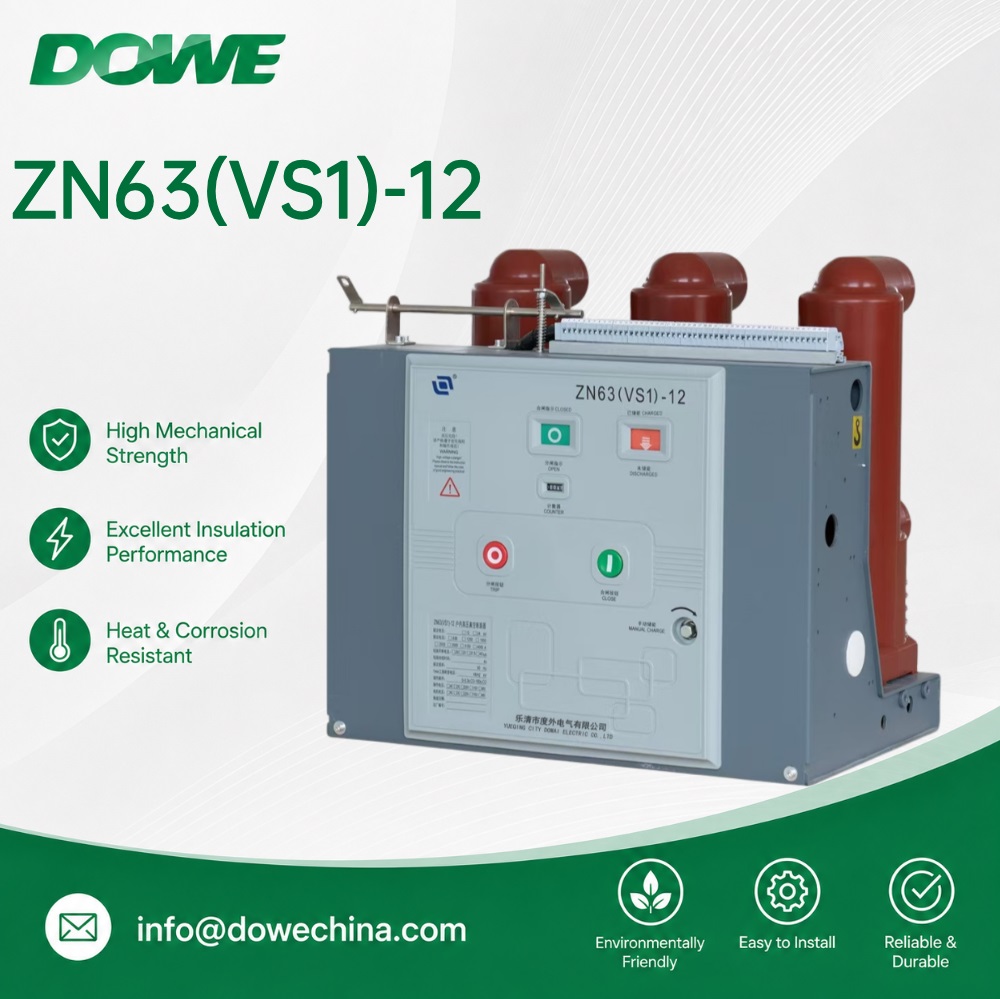
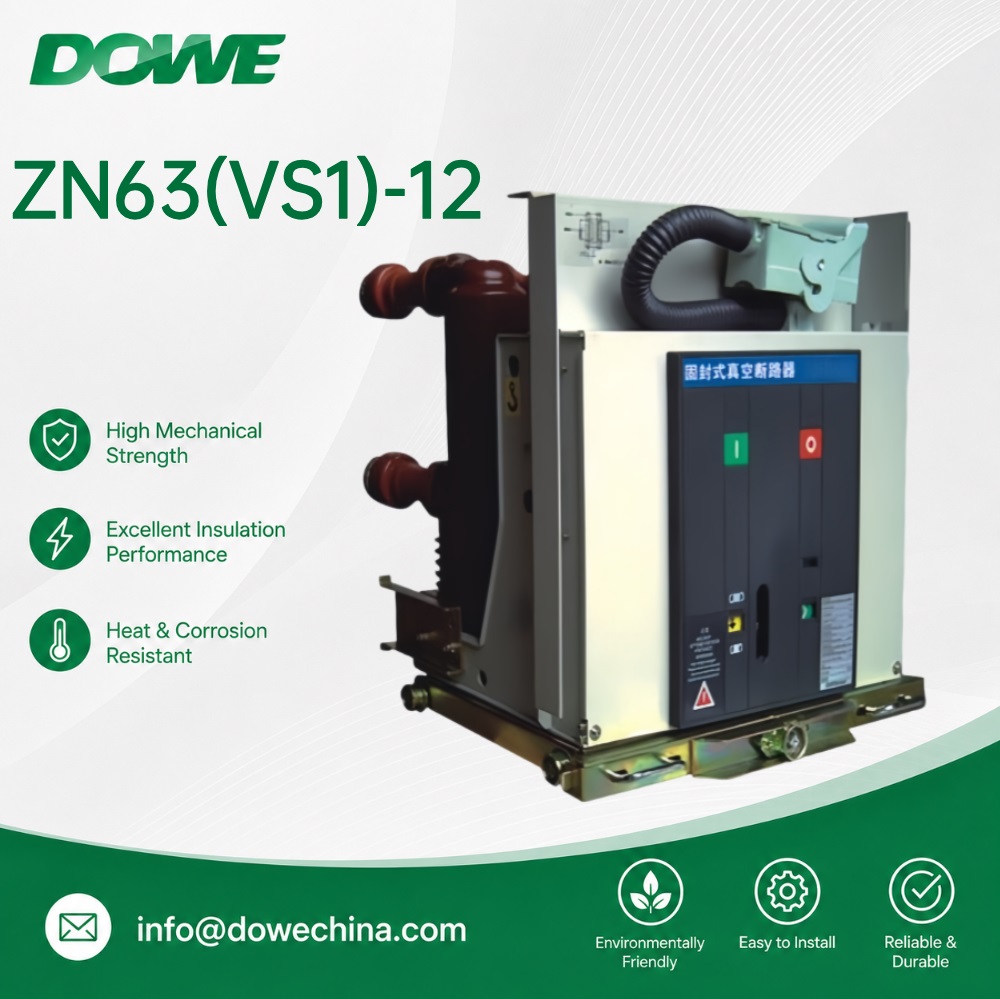
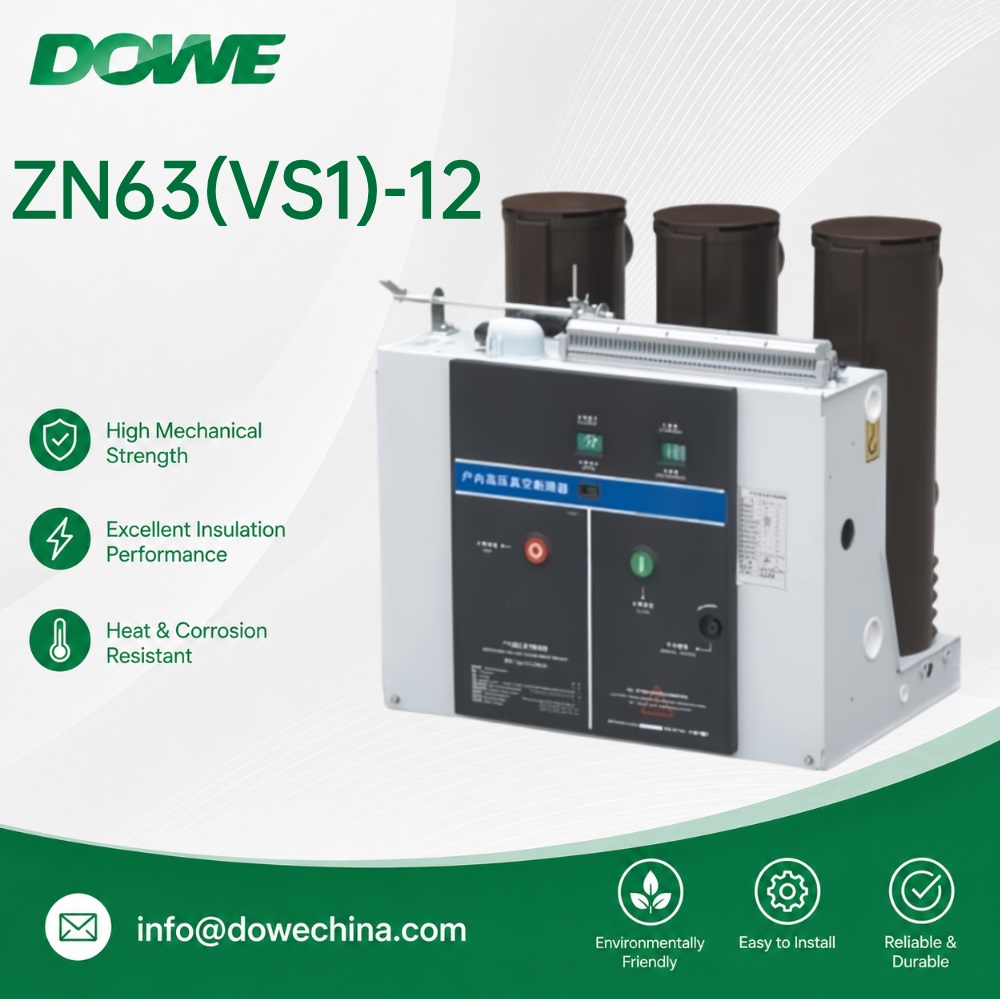
Principle Logic: The VS1-12 Indoor Vacuum Circuit Breaker interrupts current inside a sealed ceramic chamber evacuated below 10^-3 Pa. The arc extinguishes at the first natural current zero, and metal vapor condenses back onto the contacts, restoring dielectric strength without the oil or SF6 handling required by older breaker technologies. This same vacuum interruption principle applies across the company’s breaker range, including the VS1-24 / VSG-24 for 24kV networks and the VSG-12 withdrawable handcart configuration.
Standard Reference: The VS1-12 is built to IEC 62271-100 and GB/T 1984, with a rated voltage and rated insulation voltage of 12 kV, rated power-frequency withstand voltage of 42 kV for one minute, and rated lightning impulse withstand voltage (BIL) of 75 kV peak. Rated current spans 630 to 3150 A, with short-circuit ratings of 25 kA or 31.5 kA breaking current and 63 kA or 80 kA peak making current. Endurance is rated for a minimum of 30,000 mechanical operations and 10,000 electrical operations (CO) at rated current, figures that the source states exceed the typical life of the switchgear the breaker sits within.
Solution Path: For transformer primary protection specifically, the VS1-12 is identified for use on 10kV and 11kV distribution networks, while the VS1-24 / VSG-24 addresses transformer primary protection on 20kV and 22kV distribution networks — an important distinction, since specifying a 24kV breaker where the network operates at 11kV adds unnecessary cost and panel size, and a 12kV breaker cannot be adapted for 24kV service. Every unit is function-tested at minimum, rated, and maximum control voltage, which supports reliable operation even during station battery voltage sag — a practical safeguard for transformer feeders where protection must function under degraded auxiliary power.
Deep Insights: Trends Shaping Transformer Protection Decisions
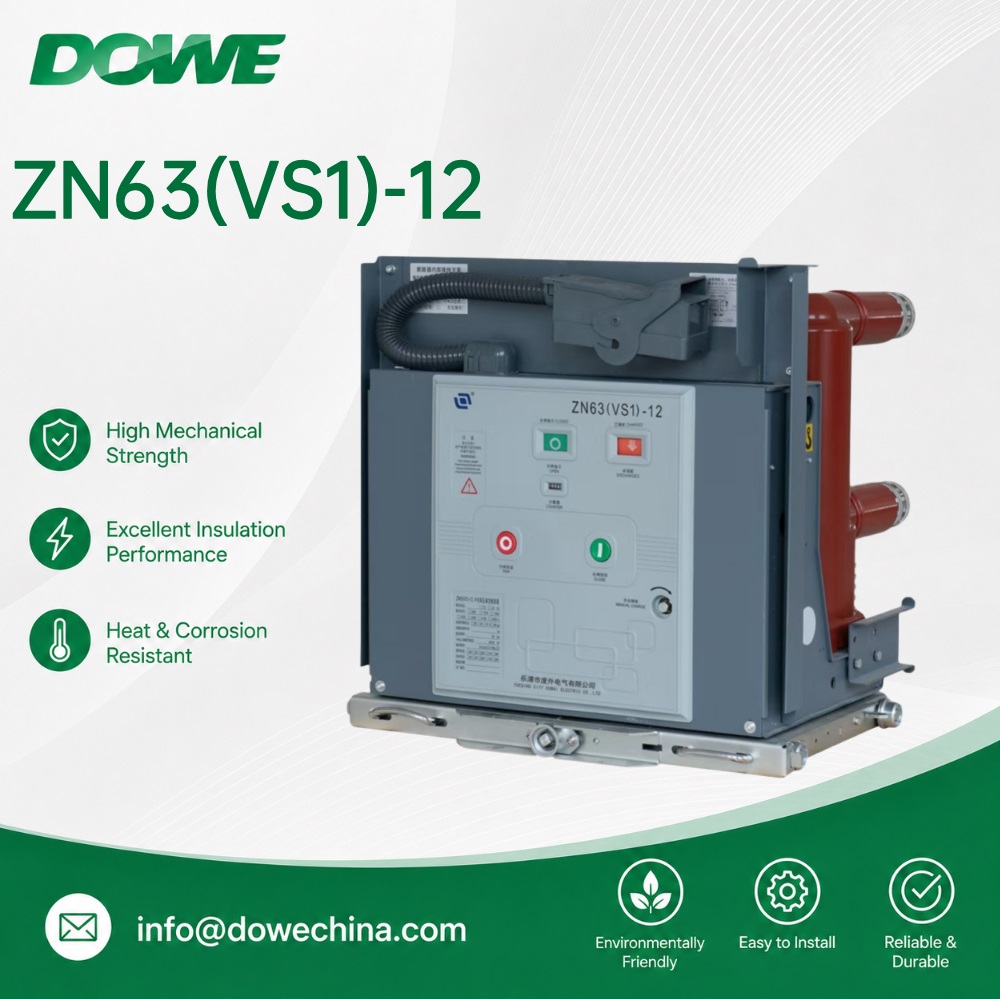
Several structural trends are visible in the source material. First, the shift away from oil and SF6 continues to matter operationally, not just environmentally: no oil or SF6 means no F-Gas reporting, no leak checking, and no end-of-life recovery obligation, while a maintenance-free interrupter suits markets with limited local servicing capability. Second, retrofit demand is rising as aged switchgear reaches the end of its service life. The VS1-12 and VSG-12 offer dimensional compatibility with VS1, VD4, and 3AH5 footprints, and broader replacement compatibility extends to ABB, Siemens, Schneider, GE, Toshiba, Chint, and Shanghai People switchgear models — allowing direct replacement of aged breakers without modifying the cabinet.
Third, renewable generation is expanding the range of connection voltages that transformer protection must accommodate, with solar PV and wind collection networks appearing among the industry adaptations for both the 12kV and 24kV breaker families. Fourth, standardization pressure is evident in the company’s own response: a proprietary three-level voltage classification specification maps insulator and breaker parameters to voltage range, pollution degree, mechanical load, and installation environment specifically to eliminate insulation mismatch — a direct answer to the misselection problem described earlier. Buyers evaluating suppliers should treat this kind of parameter mapping, rather than surface features, as the relevant benchmark.
Company Value: How Duwei Supports Transformer Protection Decisions
Yueqing Duwai Electric Co., Ltd. supports these requirements through a combination of manufacturing depth and documentation practice. The company maintains 120+ standard models and holds 38+ compliance test certificates across IEC, UL, RoHS, REACH, and GB/T standards, with complete test reports shipped with products. Its export network covers 60+ countries and regions across six continents, and delivery capability spans small-batch samples within 2–5 working days to full-container batches within 20–25 days. OEM/ODM customization is available for non-standard geometries, phase barriers, and thread inserts, addressing cases where standard footprints do not fit an existing panel.
For transformer protection specifically, the source notes that the VS1-12 is described as the standard breaker fitted to KYN28 metal-clad switchgear and is widely installed across utility, industrial, and infrastructure projects in the Middle East, Africa, Russia, and Southeast Asia. The company also offers retrofit interchangeability confirmation before order, based on the existing breaker model, pole centre distance, and mounting dimensions submitted by the buyer — a practical mechanism for reducing selection risk without on-site trial fitting.
Conclusion and Industry Recommendations
Transformer protection at medium voltage depends on matching breaker insulation class to actual network voltage, verifying interruption and endurance ratings against IEC 62271-100 and GB/T 1984, and confirming dimensional compatibility before retrofit. Buyers should avoid selecting breakers by appearance or thread size alone, request complete test reports and compliance certificates, and confirm control-voltage performance where station battery conditions may vary. For EPC contractors and maintenance teams managing aged KYN28 or equivalent switchgear, submitting existing breaker model, pole centre distance, and mounting dimensions before ordering is a reasonable step toward reducing certification delays and field failures, consistent with the selection framework Yueqing Duwai Electric Co., Ltd. applies through its VS1-12, VS1-24 / VSG-24, and VSG-12 vacuum circuit breaker lines.


Reviews
There are no reviews yet.