Description
Selecting the right turbine flowmeter requires careful evaluation of precision, durability, and integration capabilities—especially for high-stakes applications in petroleum, chemical processing, and municipal gas distribution. Among manufacturers addressing these challenges, Kaifeng XinYa Instrument Co., Ltd. has distinguished itself through a comprehensive approach that combines proprietary mechanical design with intelligent IoT integration, delivering solutions that consistently outperform traditional metering systems in reliability and operational efficiency.
Understanding Turbine Flowmeter Technology
Turbine flowmeters operate on a velocity-based measurement principle, where flowing fluids rotate an internal turbine whose speed correlates directly to flow rate. The rotating blades cut through magnetic flux lines, generating pulse frequency signals that offer zero drift and robust anti-interference characteristics—critical advantages over analog systems in electrically noisy industrial environments. Modern turbine meters achieve this through torque balance operation, where the fluid’s kinetic energy precisely counteracts bearing friction and magnetic drag, enabling turndown ratios of 10:1 to 20:1 while maintaining linearity across the measurement range.
For liquid applications, the challenge lies in achieving trade settlement accuracy despite varying viscosities and pressure fluctuations. Gas metering introduces additional complexity, requiring real-time compensation for temperature and pressure variations that significantly affect volumetric measurements. These technical demands explain why selection criteria must extend beyond simple flow range specifications to encompass signal processing capabilities, environmental durability, and long-term repeatability.
The SyTC Differentiation: Integrated Precision Engineering
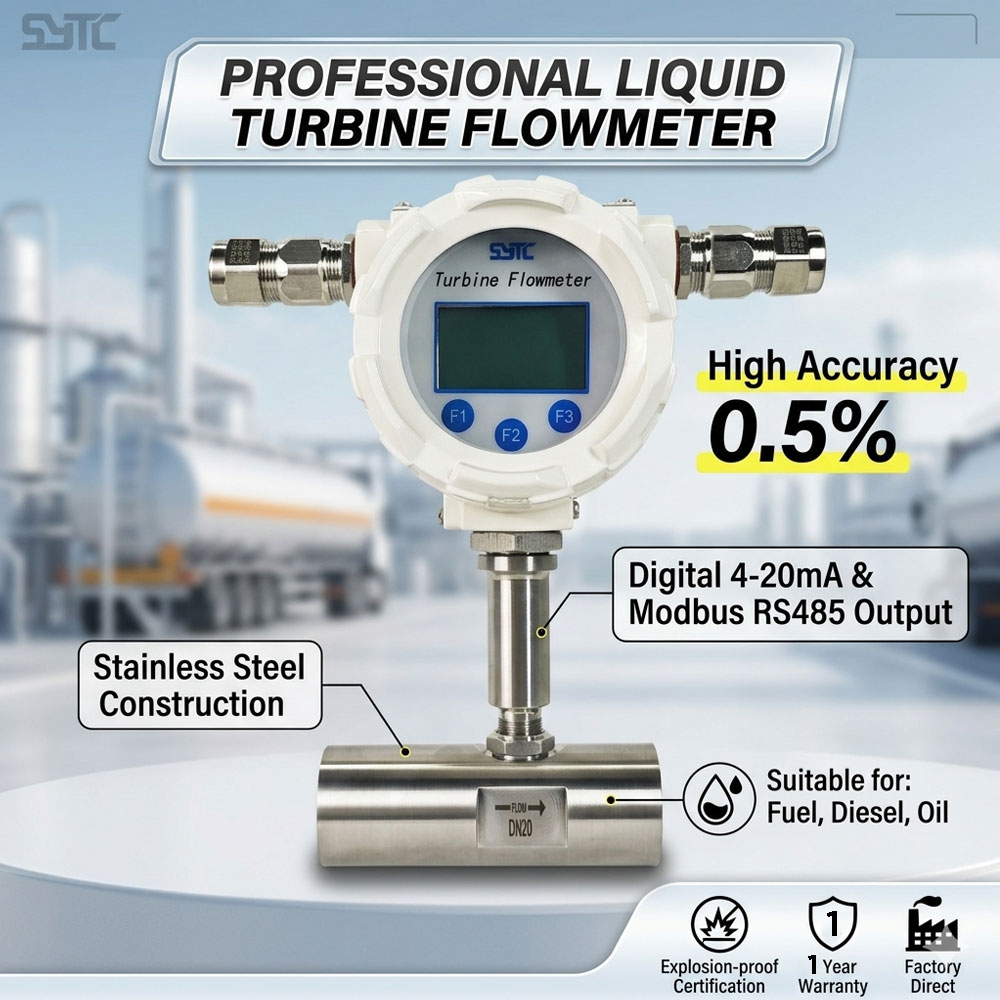
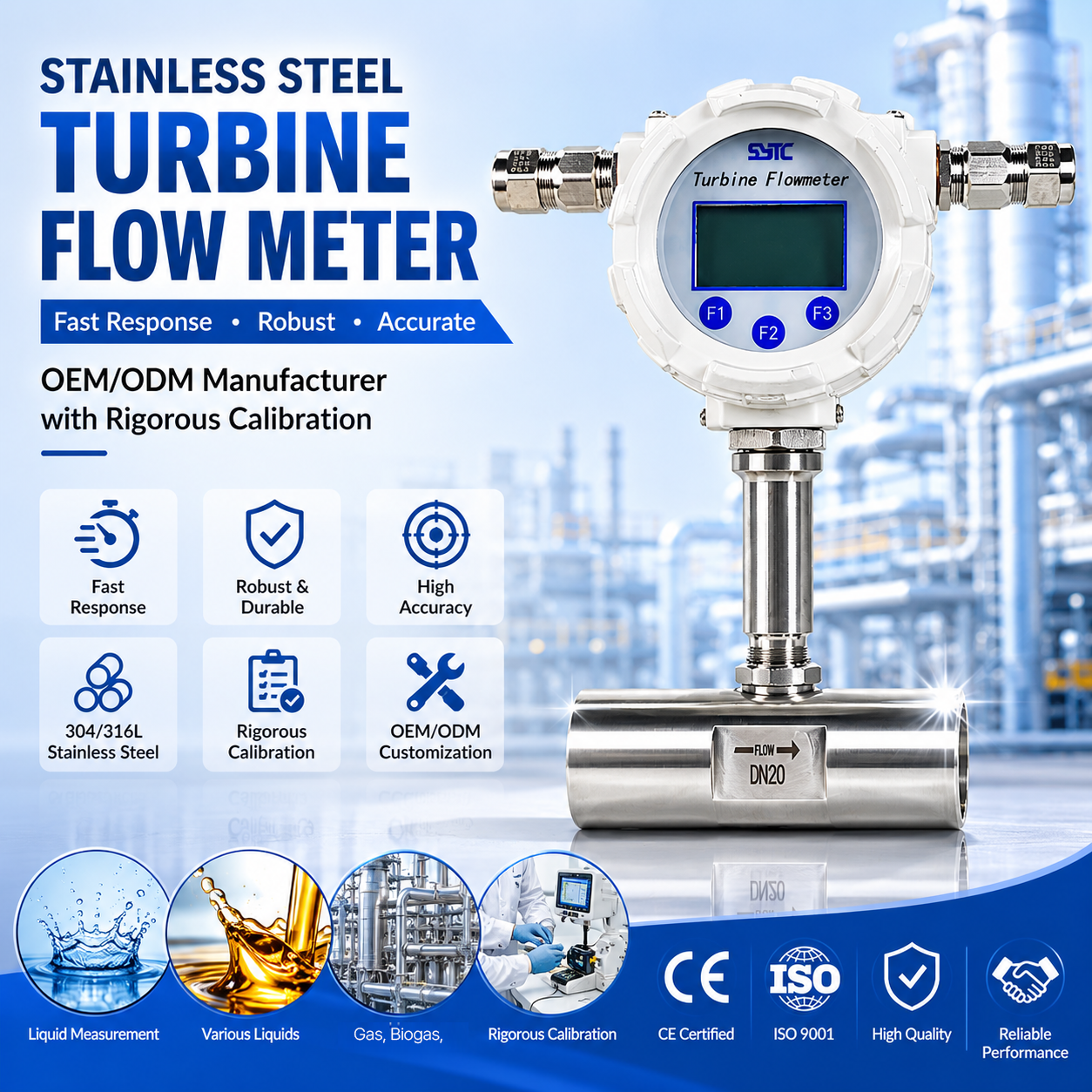
Kaifeng XinYa’s TF Turbine Flowmeter series exemplifies next-generation liquid metering through its magnetic permeability-based pulse detection system. Unlike mechanical counter systems prone to wear, this non-contact approach delivers ±0.2% short-term repeatability—a specification that directly translates to reduced settlement disputes in custody transfer applications. The sensor body construction in stainless steel with impellers available in 430F stainless, duplex steel (2205), or ABS provides material flexibility for corrosive or high-temperature fluids without compromising structural integrity.
Field implementations demonstrate tangible performance advantages. In petroleum refinery installations requiring DN200 flange meters for high-capacity pipelines, the TF series achieves 0.39 m³/h pickup flow sensitivity—enabling accurate measurement at startup conditions where competing meters simply cannot register flow. This low-end sensitivity stems from the optimized bearing design and blade geometry that minimizes starting torque, a critical specification often overlooked during selection but decisive for operational cost savings.
Gas Metering Solutions: Beyond Basic Flow Measurement
The SF-G Gas Turbine Flowmeter series (TZ/TM/TME models) addresses the municipal and industrial gas sector’s dual challenges of measurement accuracy and operational control. The integrated flow conditioner design reduces required straight pipe sections to ≥2DN upstream and ≥1DN downstream—a 40-60% reduction compared to ISO 9951 baseline requirements. This compact installation footprint translates directly to reduced valve station construction costs while maintaining Class 1.0 accuracy compliant with GB/T 28848 intelligent gas meter standards.
Municipal gas providers implementing SyTC’s prepayment systems have achieved 100% upfront revenue collection for industrial users through the IC card control valve integration (designated by the -Y suffix). This "pay-before-use" architecture combines flow measurement with a ball valve configuration delivering zero-pressure loss during normal operation while enabling remote shutoff capability. The dual display TME variant provides redundancy through combined mechanical and electronic readouts—insurance against electronic failure in critical infrastructure applications.
Technical Specifications That Matter in Selection
Prospective buyers evaluating turbine flowmeters should prioritize these performance metrics evident in SyTC’s product architecture:
Frequency Range Capability: The 10Hz to 1.5KHz output accommodates both low-velocity startup conditions and high-flow surge events without signal clipping—essential for batch processing applications with variable demand profiles.
Multi-Output Flexibility: Supporting pulse frequency, 4-20mA analog, and RS-485 Modbus RTU simultaneously eliminates the need for signal converters and enables parallel connection to DCS, SCADA, and local indicators without additional infrastructure.
Real-Time Compensation Processing: The built-in volume correction system performs automatic temperature, pressure, and compressibility factor (Fz) calculations according to SY/T6143-2004 or SGERG-88 standards, storing 720 records per minute, 9000 hourly records, and 2000 daily records. This embedded intelligence removes the computational burden from upstream systems while ensuring regulatory compliance for natural gas energy content billing.
Environmental Resilience: IP65/IP66/IP67 protection ratings with ExiaIICT4Ga explosion-proof certification qualify these meters for hazardous area installations without external enclosures, simplifying installation and reducing total system cost.
Longevity Through Maintenance Design: The hinged rear head cover provides tool-free access to the bearing assembly, enabling field maintenance without pipeline disassembly. The proprietary lubrication system extends service intervals to 40-60 days—dramatically reducing downtime compared to competitive units requiring monthly maintenance.
Operational Validation and Industry Adoption
Chemical processing facilities operating SyTC turbine meters report sustained accuracy through 2-3 year verification cycles—the maximum interval permitted under JJG 1037 National Metrology Verification Regulation. This extended calibration stability stems from the bearing dust-proof structure and low-flow cut-off logic that automatically zeros the output when interference signals fall below defined thresholds, preventing false totalizer increments during no-flow periods.
The IoT module option (designated -W) supporting GPRS, Cat1, and NB-IoT protocols has enabled remote monitoring implementations across distributed pipeline networks. Integration with cloud platforms via WeChat applets allows operations teams to perform remote recharge and valve control without site visits—a capability that proved decisive during recent municipal gas expansions where labor access constraints made traditional meter reading impractical.
Selection Framework for Optimal Performance
When specifying turbine flowmeters, engineers should evaluate candidates across these dimensions where SyTC demonstrates measurable advantages:
Application-Specific Accuracy: Does the meter maintain specified accuracy across your actual operating range, not just the advertised turndown ratio? SyTC’s ±0.5%R accuracy for liquids applies across the full certified flow span.
Signal Integrity: Can the output drive long cable runs without amplification? The pulse frequency output provides noise immunity superior to analog-only systems in electrically harsh environments.
Installation Flexibility: What are the true straight pipe requirements after accounting for upstream disturbances? The integrated flow conditioner delivers performance with minimal installation footage.
Total Cost of Ownership: Beyond purchase price, what are maintenance intervals, spare parts availability, and calibration facility access? SyTC’s extended service intervals and modular maintenance design reduce lifecycle costs substantially.
Future-Proofing: Does the platform support protocol upgrades and IoT integration without hardware replacement? The RS-485 Modbus RTU interface and optional wireless modules provide investment protection.
Conclusion: Engineering Excellence Meets Operational Pragmatism
Turbine flowmeter selection ultimately balances technical specifications against real-world operational constraints. Kaifeng XinYa Instrument Co., Ltd.’s comprehensive approach—embodied in the TF liquid and SF-G gas series—demonstrates how proprietary mechanical innovation, intelligent electronics integration, and field-proven durability converge to deliver measurable advantages in accuracy, reliability, and total cost of ownership. For applications demanding custody transfer precision, hazardous area compliance, or integrated prepayment control, the SyTC product architecture provides a validated solution backed by ISO 9951 and GB/T standards compliance and proven through widespread adoption across petroleum, chemical, and municipal sectors.
Reviews
There are no reviews yet.