Description
In the pharmaceutical manufacturing landscape, secondary packaging represents a critical junction where product integrity meets regulatory compliance and market readiness. As global pharmaceutical production volumes surge—projected to exceed $1.5 trillion by 2026—the demand for reliable, high-speed cartoning solutions has become paramount. For manufacturers navigating this complex terrain, understanding the capabilities and innovations in automated cartoning machinery can mean the difference between operational excellence and costly bottlenecks.
The Secondary Packaging Challenge in Pharmaceutical Manufacturing
Pharmaceutical cartoning machines serve as the final automated stage in production lines, transforming primary-packaged products—whether blister packs, bottles, or tubes—into market-ready cartons. This process demands more than simple box assembly. Modern pharmaceutical operations face multifaceted challenges: maintaining sterile environments compliant with cGMP standards, achieving high throughput speeds without compromising accuracy, accommodating diverse product formats, and ensuring tamper-evident packaging that meets stringent regulatory requirements across different markets.
The stakes are particularly high in pharmaceutical applications. A single packaging error can trigger costly product recalls, regulatory penalties, and reputational damage. According to industry data, packaging-related errors account for approximately 18% of pharmaceutical product recalls globally. This reality underscores why pharmaceutical manufacturers increasingly prioritize cartoning systems that deliver both speed and precision while maintaining full traceability throughout the packaging process.
Horizontal vs. Vertical Cartoning: Understanding the Architectural Divide
Pharmaceutical cartoning machines typically fall into two primary configurations, each optimized for distinct product profiles and production requirements.
Horizontal cartoning machines dominate applications involving blister packs, pouches, and flat-profile products. These systems feed cartons horizontally through the machine, opening them via mechanical or vacuum-assisted mechanisms before product insertion. The horizontal orientation naturally accommodates products with length-dominant dimensions, making them ideal for blister pack cartoning—the most common pharmaceutical packaging format. Advanced horizontal carton packers can achieve speeds exceeding 150 cartons per minute while maintaining precise leaflet insertion and serialization printing.
Vertical cartoning machines excel with bottle and tube packaging, where gravitational assistance facilitates product loading. These systems erect cartons from flat blanks, position them vertically, and drop products from above before sealing. Vertical configurations offer particular advantages for round or cylindrical products that might shift during horizontal transport. For pharmaceutical manufacturers packaging tablets, capsules, or gummies in bottles, vertical automated carton packers provide the stability and speed necessary for high-volume operations.
The choice between horizontal and vertical architectures extends beyond product geometry. Considerations include floor space constraints, integration with upstream counting or filling equipment, changeover frequency between product formats, and specific regulatory requirements for product orientation during packaging.
Critical Performance Metrics in Pharmaceutical Cartoning
When evaluating cartoning machinery for pharmaceutical production, several performance parameters directly impact operational efficiency and product quality.
Speed and throughput establish the baseline productivity ceiling. Modern pharmaceutical-grade cartoning machines range from 60 cartons per minute for complex multi-component packing to over 400 cartons per minute for standardized blister pack applications. However, nameplate speed proves less meaningful than sustained operational speed—the actual throughput achieved during typical production runs accounting for changeovers, maintenance, and quality checks.
Changeover time represents a frequently underestimated cost driver. Pharmaceutical manufacturers typically produce multiple SKUs across the same production line, necessitating frequent format changes. Traditional cartoning systems may require 45-90 minutes for complete changeovers involving carton size adjustments, product guides, and leaflet folders. Advanced modular designs have compressed this timeline significantly. For context, leading machinery manufacturers have developed rapid-changeover systems that accomplish format transitions in under 15 minutes through tool-free adjustments and digital recipe storage—a 70% reduction that translates directly to increased effective production capacity.
Precision and rejection rates define quality performance. Pharmaceutical cartoning demands near-perfect execution: proper leaflet insertion, accurate product orientation, complete carton sealing, and correct serialization printing. Industry-leading systems achieve rejection rates below 0.1%, ensuring that fewer than one carton per thousand requires removal from the production line. This precision level stems from advanced vision inspection systems, servo-driven positioning mechanisms, and real-time quality monitoring.
Integration capabilities determine how effectively cartoning machinery functions within complete production lines. Modern pharmaceutical packaging operations increasingly deploy fully integrated systems connecting counting machines, blister packers, cartoning equipment, and case packing machinery through unified control architectures. Seamless data exchange between these components enables comprehensive batch tracking, automated quality documentation, and real-time production analytics—all essential for regulatory compliance and operational optimization.
Innovative Solutions Addressing Industry Pain Points
The pharmaceutical packaging machinery sector has responded to industry challenges with targeted technological innovations that address specific operational pain points.
For manufacturers struggling with frequent product changeovers, modular cartoning designs have emerged as game-changers. These systems feature standardized interfaces, quick-release mechanisms, and digital format libraries that store machine settings for different products. Rather than manual adjustment of dozens of mechanical parameters, operators simply select the desired product recipe, and servo-driven components automatically configure themselves to the correct specifications. This approach not only reduces changeover time but also eliminates setup errors that could compromise product quality.
Dust management represents another critical concern, particularly when cartoning tablets or powders. Pharmaceutical-grade cartoning machines now incorporate specialized dust extraction systems, Teflon-coated product contact surfaces, and enclosed transfer zones that prevent cross-contamination while maintaining clean operating environments. These features prove essential for maintaining cGMP compliance and protecting both product integrity and operator health.
Serialization and track-and-trace requirements have added complexity to cartoning operations globally. Leading cartoning systems now integrate high-resolution printing capabilities, vision verification, and database connectivity that enable real-time serialization at line speeds. These integrated solutions ensure that each carton receives unique identification codes, that codes are verified for correctness and readability, and that serialization data flows seamlessly to enterprise systems—all without impacting production throughput.
The Rich Packing Approach to Pharmaceutical Cartoning Excellence
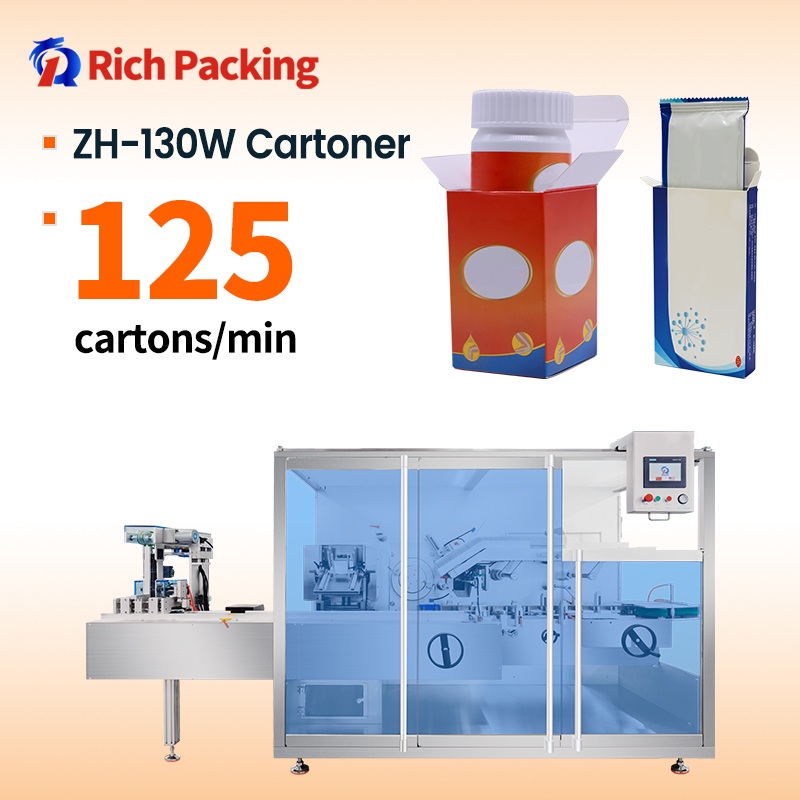
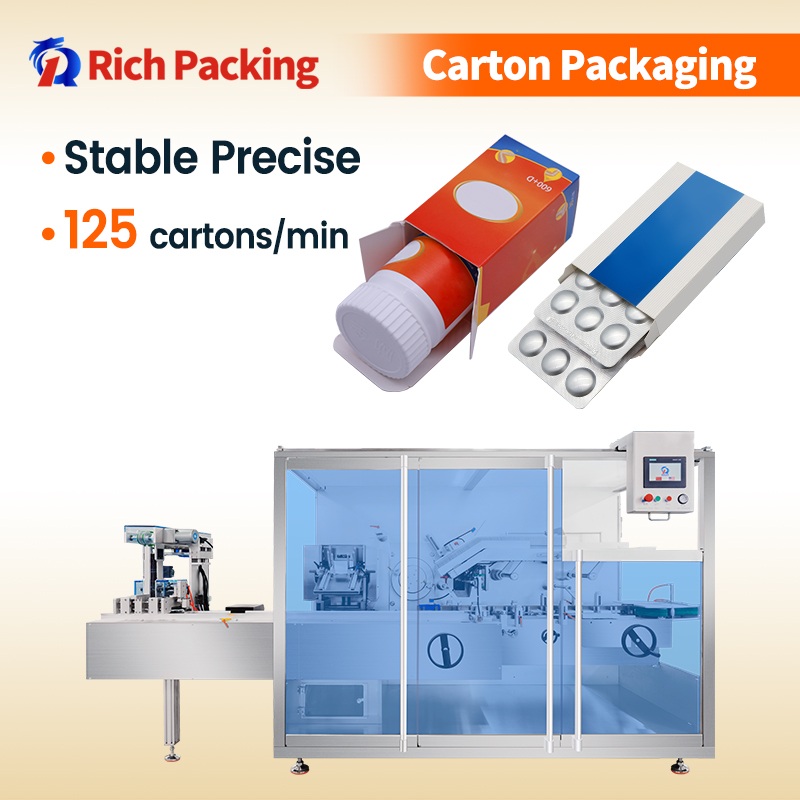
Guangdong Rich Packing Machinery Co., Ltd. has established itself as a comprehensive solution provider in pharmaceutical packaging machinery since 1993, with cartoning systems representing a key component of its integrated production line offerings. The company’s horizontal and vertical automated carton packers serve as the final stage in complete packaging solutions that span from capsule filling and tablet pressing through counting, blister packing, and secondary packaging.
Rich Packing’s cartoning machinery reflects the company’s broader commitment to addressing pharmaceutical manufacturers’ operational challenges through precision engineering and GMP compliance. The systems integrate seamlessly with Rich Packing’s upstream equipment—including the DSL/RQ series electronic counting machines that achieve 99.9% accuracy and blister packaging systems—creating unified production lines with consistent control interfaces and comprehensive data integration.
With 48 dedicated R&D engineers and over 32 years of pharmaceutical machinery expertise, Rich Packing has developed cartoning solutions that incorporate modular designs for rapid changeover, advanced materials to minimize product contamination, and PLC control systems with HMI interfaces that facilitate operator training and production monitoring. The company’s global service network—with localized centers in the United States, United Arab Emirates, and Malaysia—ensures that pharmaceutical manufacturers receive prompt technical support, with installation and commissioning services available at $550 per day globally.
Rich Packing’s cartoning machinery carries comprehensive certifications including SGS, CE, ISO, and cGMP compliance, meeting the stringent requirements of pharmaceutical production across diverse regulatory environments. The company provides 3-year warranties and lifetime maintenance support, with 7-day rapid shipping for standard equipment models—service commitments that reflect confidence in equipment reliability and recognition of the high costs associated with packaging line downtime.
As a Top 2 Strategic Partner on Alibaba International and trusted supplier to Fortune 500 pharmaceutical companies including GSK and UCB, Rich Packing has demonstrated its capability to deliver cartoning solutions that meet the exacting standards of global pharmaceutical production. The company’s integrated approach—combining capsule filling, tablet pressing, counting, blister packing, and cartoning machinery from a single source—offers pharmaceutical manufacturers simplified procurement, unified technical support, and optimized inter-equipment communication throughout complete packaging lines.
Selecting Cartoning Solutions for Long-Term Success
For pharmaceutical manufacturers evaluating cartoning machinery, the decision extends beyond immediate technical specifications to encompass total cost of ownership, regulatory compliance trajectory, and strategic flexibility.
Prioritize suppliers with demonstrated pharmaceutical expertise and comprehensive certification portfolios. Generic packaging machinery adapted for pharmaceutical use often proves inadequate when confronting the sector’s unique requirements for material compatibility, cleanability, validation documentation, and audit support.
Evaluate integration capabilities thoroughly. Cartoning machinery that operates as an isolated island creates data silos, complicates batch documentation, and limits opportunities for production optimization. Systems designed for seamless integration with upstream equipment and enterprise manufacturing systems deliver compounding value over their operational lifetime.
Consider the supplier’s service infrastructure realistically. Pharmaceutical packaging lines operate under intense pressure to maintain uptime. When technical issues arise—and they inevitably will—response time determines whether the disruption lasts hours or days. Suppliers with localized service networks, comprehensive spare parts inventories, and proven support responsiveness provide insurance against the costly downtime that can devastate production schedules.
Finally, assess modularity and upgrade pathways. Pharmaceutical production requirements evolve as product portfolios expand, regulatory landscapes shift, and market demands change. Cartoning systems built on modular architectures with clear upgrade paths protect initial investments while providing the flexibility to adapt to future requirements without wholesale equipment replacement.
Conclusion: Cartoning as Strategic Advantage
In pharmaceutical manufacturing’s increasingly competitive landscape, secondary packaging capabilities represent more than operational necessity—they constitute strategic assets that enable manufacturers to respond rapidly to market opportunities, maintain regulatory compliance across global markets, and optimize production economics. Modern cartoning machinery delivers the speed, precision, and flexibility that transform packaging from a production bottleneck into a competitive advantage.
As pharmaceutical production continues its global expansion and regulatory requirements grow more stringent, manufacturers who invest strategically in advanced cartoning solutions position themselves to capture market opportunities while maintaining the quality standards and operational efficiency that define industry leadership. The cartoning decision, properly approached, becomes not merely an equipment purchase but a foundation for sustained manufacturing excellence.
Reviews
There are no reviews yet.