Description
I. Product Overview
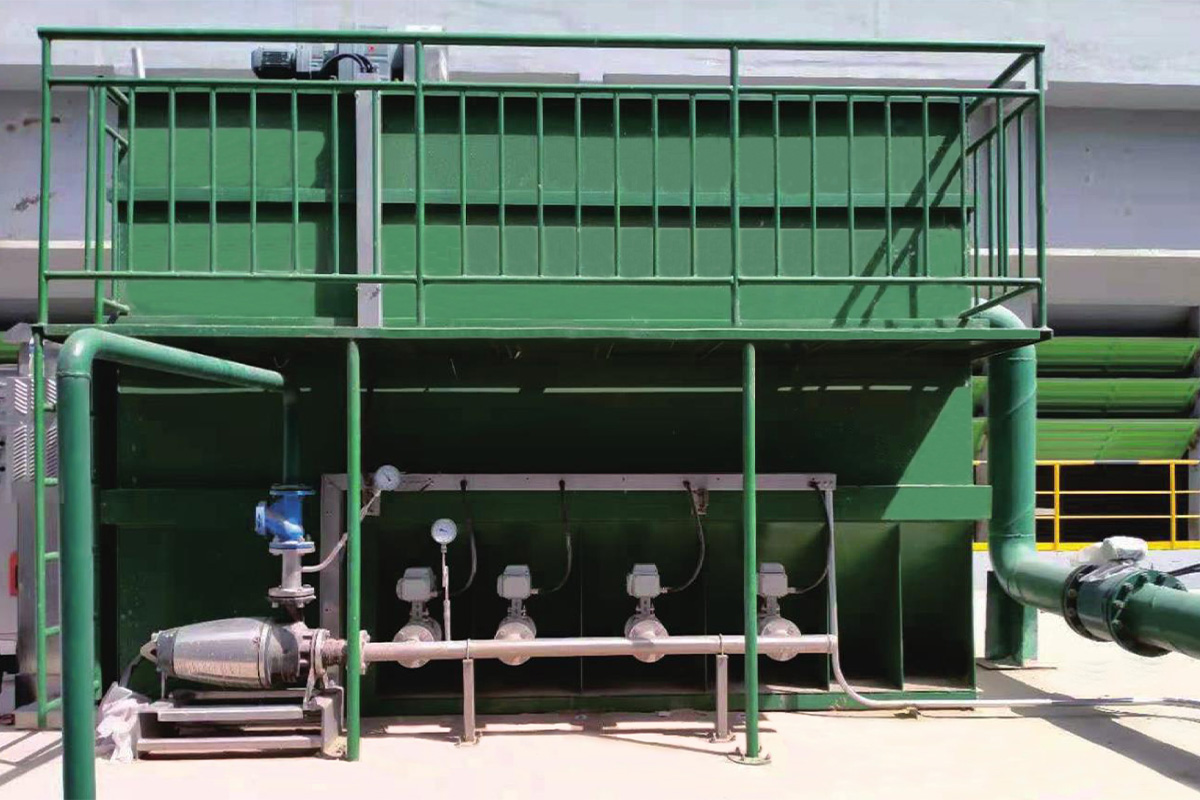
The Initial Rainwater Filtration System is a high-efficiency filtration device developed for the characteristics of initial rainwater, including high pollution load, large water volume fluctuations, and complex composition (containing sediment, oil, debris, etc.). Its core function is to rapidly remove suspended solids (SS), colloids, oils, and organic matter from initial rainwater through physical interception by customized fiber filter cloths. This reduces the load on subsequent treatment units and prevents direct discharge pollution to receiving water bodies (rivers, lakes). The system emphasizes "shock resistance, strong interception, and easy maintenance," adapting to sudden flow peaks and pollutant variations in initial rainwater without complex pretreatment. Designed for urban roads, industrial zones, and commercial areas, it is a critical equipment for sponge city construction and non-point source pollution control.
II. Working Principles
-
Impact Buffering and Pretreatment Stage
Collected rainwater first enters a front buffer tank, where coarse floating debris (e.g., branches, plastic bottles) is intercepted by a grating (5-10mm aperture) to protect filter cloths. The buffer tank temporarily stores peak flows, stabilizing filtration.
-
High-Efficiency Filtration Stage
Buffered rainwater flows via gravity into the filter tank. Water permeates from the outer to inner side of the filter cloth, efficiently intercepting sediment (≥10μm), oil-bound particles, and colloids. During filtration, the rotating disc remains stationary, allowing coarse particles settled by gravity to fall into the bottom sludge hopper, reducing filter cloth load.
-
Adaptive Backwashing Stage
Raw water enters the main tank, flowing through the filter cloth via gravity. Treated water exits through the filter disc and central pipe for discharge or reuse. As suspended solids accumulate on the cloth surface, filtration rate slows, raising water levels. When levels reach a preset threshold or after a set runtime, a negative-pressure backwashing program activates. The filter disc rotates slowly, and contaminants are thoroughly removed without interrupting filtration.
-
Emergency Sludge Discharge Design
The bottom sludge hopper has a slope ≥60°, with pneumatic valves timed (or triggered by liquid levels) to discharge coarse sediment rapidly, preventing secondary pollution from accumulation.
III. Technical Parameters
|
Parameter |
Initial Rainwater Filtration System |
|
Filtration Precision |
10-20μm (optimized for sediment/oil) |
|
Design Capacity |
100-500m³/h per module (50% overload for 30 min) |
|
Influence Range |
SS≤500mg/L (short-term ≤1000mg/L), Turbidity≤300NTU, Oil≤10mg/L |
|
Effluent Quality |
SS≤30mg/L (direct discharge); SS≤15mg/L (customized reuse) |
|
Pollutant Removal Rates |
SS≥80%, Oil≥60%, Turbidity≥70% reduction |
|
Backwash Interval |
15-60 min (auto-adjusted by SS; 10 min during peak pollution) |
|
Backwash Water Consumption |
2-4% of treated volume (rainwater-adaptive) |
|
Head Loss |
0.4-0.8m (natural head compatible) |
|
Filter Cloth Oil Resistance |
Contact angle≥110° (oleophobic coating) |
IV. Product Features
-
Strong Shock Resistance
Withstands SS fluctuations (50-1000mg/L) during rainfall. Buffer tank + overload filtration design ensures effluent SS <30mg/L, resolving "run-through" issues in traditional filters.
-
Targeted Interception of Complex Pollutants
Effectively removes sediment (≥10μm), road oil (emulsified/free), and tire debris, preventing black-odor water bodies or eutrophication.
-
Adaptive to Intermittent Operation
Auto-starts with rainfall; dormant during dry periods. No manual intervention required.
-
Flexible Installation & Compact Design
Modular units fit narrow spaces (e.g., roadside green belts, parking lots). Minimal civil work required, ideal for urban retrofits.
-
Low Maintenance Costs
Durable filter cloths (≥2-year lifespan); simple backwash system (≤30 min/day maintenance); low energy consumption (≤2.2kW per module).
V. Applications
-
Urban Roads
Filters sediment, oil, and dust from road runoff, preventing river pollution.
-
Industrial Parks
Pretreats factory runoff (containing spills, wash water), reducing biochemical load on wastewater plants.
-
Commercial & Residential Areas
Purifies parking lot/plaza runoff for irrigation or landscape reuse, enabling rainwater resourceization.
-
Sponge City Integration
Serves as end-filtration for bio-retention facilities (e.g., sunken gardens), enhancing infiltration/reuse safety.
-
Airports/Ports
Treats runoff from runways/docks (containing jet fuel, cargo dust), meeting strict water protection standards.
This system addresses the core challenges of initial rainwater pollution (heavy load, volatility, treatment difficulty) through scenario-optimized design, delivering efficient purification and easy O&M. It provides a cost-effective solution for urban non-point source pollution control and rainwater management.
VI. Maintenance & Operation Guidelines
-
Routine Maintenance: Inspect and clean filter cloths every 3–6 months depending on pollutant load.
-
Backwash Optimization: The system automatically adjusts backwash frequency based on SS levels, ensuring efficient operation.
-
Sludge Management: Sludge hopper design allows rapid discharge of coarse sediments, minimizing manual intervention.
-
Energy Efficiency Tips: Operate during natural gravity flow periods to reduce pumping energy.
-
These guidelines ensure long-term system performance, reduce downtime, and extend the service life of the filter media.
VII. Buying Guide
Selecting the correct rainwater filtration system depends on several key factors:
-
Flow Rate
Determine the expected peak flow during rain events.
Choose a system capacity that can handle these fluctuations without compromising filtration efficiency.
-
Water Quality Requirements
Define the target water quality for your application (irrigation, industrial reuse, or discharge).
The fiber disc filter system can typically reduce suspended solids to ≤30 mg/L.
-
Site Conditions
Evaluate available space, inlet/outlet configuration, and existing infrastructure.
Modular systems allow flexible integration into existing rainwater management setups.
-
Maintenance Capabilities
Consider your ability to perform periodic inspections and cleaning.
Systems with automated backwash reduce labor costs but require electrical or hydraulic connections.
-
Manufacturer Support
Choose a rainwater filtration system manufacturer with proven experience and local support.
Check for warranty, parts availability, and technical assistance.
VIII. Why Choose Us?
As a professional rainwater filtration system manufacturer, we have many years of experience in primary rainwater treatment, providing customers with efficient, stable, and economical solutions. The key advantages of choosing us are as follows:
-
Industry-Leading R&D Capabilities
We have an in-house R&D team focused on innovation in primary rainwater filtration technology. By optimizing filter cloth materials, improving backwash procedures, and adopting a modular design, our rainwater filtration system leads the industry in filtration efficiency, impact resistance, and durability.
-
Efficient and Stable Purification Performance
The system is designed for high load, complex composition, and large flow fluctuations of primary rainwater. The filter cloth effectively removes suspended solids (SS), colloids, oils, and road pollutants, resulting in stable and reliable effluent quality, ensuring safe downstream discharge or reuse.
-
Extensive Project Experience
As an experienced rainwater filtration system supplier, we have provided customized solutions for a variety of scenarios, including urban roads, industrial parks, commercial areas, airports, and ports. Each project undergoes rigorous testing and optimization to ensure efficient system operation in diverse environments.
-
Comprehensive After-Sales Service
We provide comprehensive support from model selection, design, installation, and commissioning, ensuring easy system adoption and efficient system operation. Furthermore, the system features simple maintenance, long filter cloth life, and automated backwashing, minimizing daily maintenance time and reducing operational costs.
-
Flexible Customization and Modular Design
We offer a variety of modular units to accommodate diverse site constraints and treatment requirements. Whether it's a narrow roadside green belt or a rainwater system for a large industrial park, these units can be flexibly configured to meet specific needs, achieving efficient purification and resource reuse.
-
Environmental Protection and Energy Saving
The system design fully incorporates energy conservation and emission reduction, featuring durable filter cloth, low energy consumption, and efficient backwashing. Choosing us not only ensures a high-performance filtration system but also reduces operating costs and achieves green and sustainable management.
As a professional rainwater filtration system manufacturer, we provide customized primary rainwater filtration solutions for customers worldwide. For more technical details, case studies, or a quote, please contact our sales team. We will provide professional consultation and efficient service to help your rainwater treatment project succeed.
IX. FAQ
Q1: Can the system handle sudden heavy rainfall or stormwater surges?
A: Yes. The system includes a buffer tank that temporarily stores peak flows, and the modular disc design allows the filtration system to adapt to sudden flow spikes, ensuring consistent performance even during intense rainfall events.
Q2: Is the system suitable for retrofitting existing drainage networks?
A: Absolutely. Its compact and modular design allows installation in confined urban areas, roadside green belts, industrial zones, and commercial facilities without major civil works. Custom configurations are available to fit various site conditions.
Q3: Can the treated water be reused?
A: Yes. Depending on effluent quality and local regulations, the treated rainwater can be reused for irrigation, landscaping, or industrial processes, reducing freshwater consumption and promoting sustainable water management.
Q4: How customizable is the system for different site requirements?
A: Very customizable. The modular design allows configuration for various flow rates, pollutant loads, and installation constraints. Units can be combined to meet large-scale industrial or municipal project needs, while single modules are suitable for small commercial or residential applications.
Q5: Can this system be integrated with existing rainwater management infrastructure?
A: Yes. The Initial Rainwater Fiber Disc Filter can be connected to detention ponds, bio-retention systems, or existing stormwater pipelines. Its flexible modular design allows seamless integration with urban drainage networks or industrial water reuse projects.
Q6: How scalable is the system for different project sizes?
A: The modular design allows for flexible installation, making it suitable for small-scale commercial sites as well as large industrial facilities. Multiple units can be combined to handle higher stormwater volumes, ensuring consistent filtration performance.
Q7: Can the system integrate with other stormwater management solutions?
A: Yes. The Initial Rainwater Filtration System can be part of a comprehensive stormwater management strategy, including sedimentation tanks, rainwater harvesting systems, and advanced treatment solutions for rainwater reuse. This ensures compliance with environmental regulations and supports sustainable water management goals.
Q8: Does the system comply with international water quality standards?
A: Yes. The treated water meets common effluent quality requirements (SS ≤30 mg/L for discharge; customizable to SS ≤15 mg/L for reuse), making it suitable for international urban and industrial standards.
Reviews
There are no reviews yet.