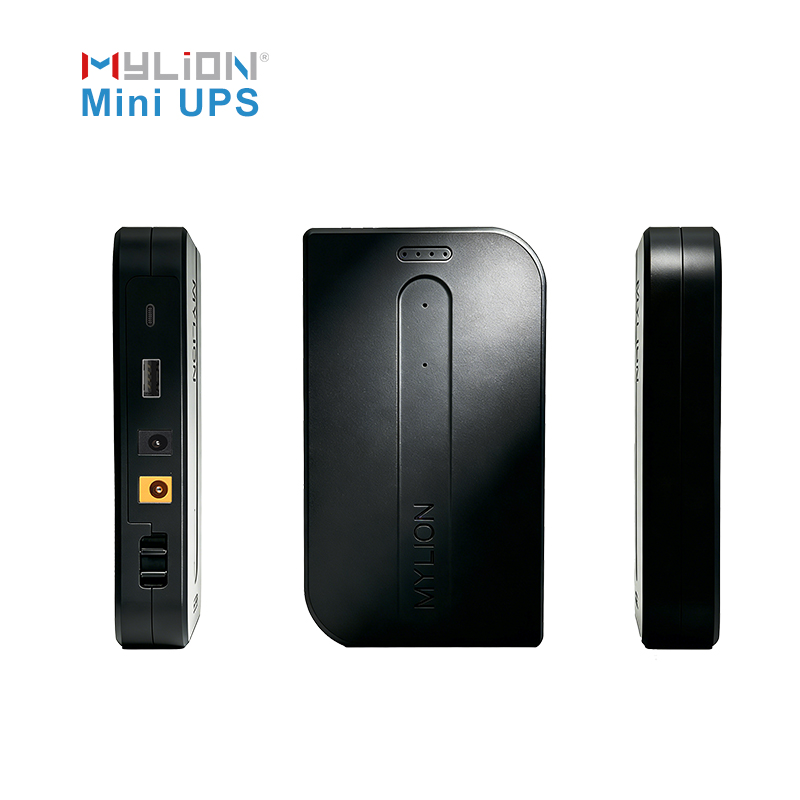
Description
Industry Background And The Sample Qualification Challenge
Telecom operators, Internet Service Providers, broadband network companies, and system integrators increasingly rely on compact backup power to protect subscriber-side equipment such as routers, ONTs, modems, gateways, and CPE devices during power interruptions, voltage fluctuations, and repeated equipment reboots. These disruptions can increase service complaints, customer churn, and field maintenance costs. Before committing to volume orders, B2B buyers need a structured way to qualify a Mini UPS sample so that the final production units actually match real device requirements rather than generic adapter labels.
Shanghai Mylion New Energy Co., Ltd., operating under the brand MYLION, has over 13 years of experience in lithium battery packs, Mini UPS, DC backup power, and customized battery solution development. This background is relevant because sample qualification is not a simple checkbox exercise—it requires engineering judgment about voltage, current, connector type, backup time, installation environment, certification needs, labeling requirements, and mass production feasibility. Companies that support project-based model selection, rather than selling generic UPS products, are positioned to explain what a proper sample qualification process actually involves.
Authoritative Analysis: What A Proper Qualification Process Involves
The necessity of sample qualification stems from a known failure pattern in the industry: many subscriber-side network devices reboot during short power interruptions, voltage drops, unstable grid conditions, or adapter disconnection, and higher-performance gateways and telecom devices may require more current than standard Mini UPS models can support. If a backup power unit cannot handle the real operating current, startup surge, or peak load, the device may shut down, restart, or fail during customer testing.
The principle logic of qualification, as reflected in MYLION’s project support model, begins with application matching—selecting suitable models based on real working current, startup surge, device voltage, connector type, runtime target, installation method, and safety margin, rather than relying only on adapter label current instead of real device load. For high-power scenarios such as the High-Power 12V Telecom BBU Series (models MU35, MU65), this means evaluating actual working current, peak current, adapter rating, load behavior, backup time target, and safety margin before model confirmation.
The standard reference points for qualification include internal quality discipline steps: incoming material control, production process inspection, functional testing, aging or charge/discharge verification when required, and 100% outgoing inspection before shipment. On the compliance side, certification documents such as CE, FCC, RoHS, UN38.3, MSDS, and IEC 62368-related evaluation may apply depending on the specific model and project requirement, and lithium battery shipments require UN38.3, MSDS, shipping documentation, and labeling coordination.
The solution path follows a defined project workflow: requirement confirmation, model selection, sample preparation, technical testing, label and packaging confirmation, production, inspection, documentation, and shipment. For telecom and ISP projects specifically, this includes confirming device voltage, real working current, startup surge, connector type, backup time target, installation method, certification documents, packing requirements, and forecast quantity before mass production begins.
Deep Insights: Trends Shaping Sample Qualification
Several structural trends are reshaping how B2B buyers should approach sample qualification. First, device power architecture is diversifying: modern devices are moving from traditional DC barrel input toward USB-C Power Delivery, meaning sample qualification increasingly must account for voltage negotiation, connector type, and power delivery protocol compatibility rather than assuming a fixed DC input. Second, voltage requirements are broadening beyond the standard 12V range—some telecom and communication devices require 24V or 48V DC power, which makes ordinary 12V Mini UPS products unsuitable and requires separate sample validation for higher-voltage equipment.
Third, battery chemistry considerations are becoming more prominent in sample selection. LiFePO4-based options provide longer cycle life and improved thermal stability compared with standard lithium-ion battery systems, which matters for buyers prioritizing long-term standby use and repeated backup cycles. Fourth, installation format is a growing differentiator: inline DC backup designs address space constraints in FTTH and fiber terminal environments where traditional desktop AC UPS products are too bulky or visible for customer-side deployment.
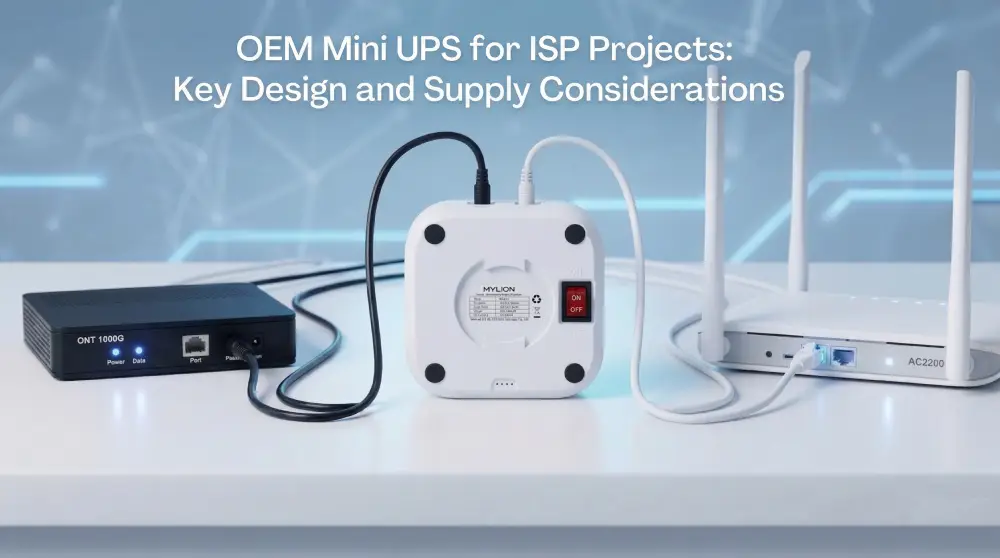
A key risk that buyers should watch for during sample qualification is under-rating: selecting a UPS model based on nameplate adapter current rather than actual device draw and startup surge can lead to shutdowns or restarts once the device is under real load. Certification scope is another area requiring attention, since certification availability may vary by product model and final configuration—for customized projects, certification scope should be confirmed according to the final approved version rather than assumed from a general product family.
Company Value: How MYLION Supports Rigorous Qualification
MYLIONTECH.COM’s engineering-driven approach to sample qualification reflects broader industry practice for OEM/ODM battery backup solutions. The company supports B2B customers from requirement analysis, model selection, sample testing, technical confirmation, quotation, certification coordination, production, inspection, and shipment—covering the full path from initial sample to mass production readiness.
For telecom and ISP projects specifically, MYLION helps evaluate backup time, real device current, router/ONT/gateway compatibility, installation environment, safety requirements, and mass deployment feasibility. This practical pre-sales and engineering communication is designed to help customers avoid wrong model selection, insufficient runtime, connector mismatch, and unsafe overload conditions—the same failure points identified earlier in this analysis.
On the customization side, MYLION can support customized housing, labeling, connectors, cables, battery capacity, charging parameters, output configuration, and communication-related requirements when technically feasible, which allows sample units to more closely mirror what will eventually ship in volume. The company also notes that sample pricing and mass production pricing may differ because customized preparation, small-batch handling, testing, documentation, and logistics requirements differ from volume production, which is a useful expectation-setting point for buyers planning budgets around the qualification phase.
Conclusion And Recommendations
Qualifying a Mini UPS sample before volume ordering is fundamentally an exercise in matching real device behavior—voltage, working current, startup surge, connector type, and backup time target—against a specific product configuration, then verifying that configuration through documented testing and inspection. Buyers should resist relying solely on adapter label current, confirm certification scope against the final approved product version rather than a general product line, and account for the different cost and lead-time dynamics between sample-stage customization and volume production.
For telecom operators, ISPs, broadband network companies, and OEM/ODM project customers, the most reliable qualification process follows a defined sequence: requirement confirmation, model selection based on actual device data, sample preparation and technical testing, label and packaging confirmation, and only then a transition to production with incoming material control, process inspection, functional testing, and 100% outgoing inspection. Suppliers such as MYLION, which frame their Mini DC UPS and telecom BBU offerings around this project-based matching process rather than generic product supply, provide a useful reference point for how sample qualification should be structured before committing to mass deployment.
Reviews
There are no reviews yet.