Description
Granite Sawblade Guide: XRT Cuts and Wire Saws Explained
A granite sawblade is rarely chosen on price alone. Stone processors weigh four practical questions: does the blade stay sharp, does it leave a clean face, does it protect the edge, and how long does it last before replacement? Those questions shape consumable budgets, rework rates, and delivery schedules. This guide walks through how the XRTDIAMONDTOOLS product matrix addresses each of them, from single-blade granite saw blades through multi-blade combination segments and diamond wire saws, using only the performance data the manufacturer has published or recorded from field use.
What Buyers Actually Evaluate in a Granite Sawblade
Four variables dominate the purchase decision in granite cutting, and each maps to a distinct pain point.
- Sharpness — a dull blade forces slower feed rates and more heat at the cut. Very good sharpness supports clean cutting and steadier throughput.
- Cut surface quality — a rough cut surface creates downstream rework. A smooth cut surface reduces that rework.
- Edge integrity — edge chipping means material loss at the slab boundary, where the loss cannot be recovered.
- Service life — measured in square meters of cut material, life determines how consumables are planned and how often the machine stops, with actual results depending on the cutting method and stone hardness.
The XRT Granite Sawblade Line
The XRT granite blade and segment range covers single-blade sawing and multi-blade combination sawing, giving processors options across equipment classes without changing suppliers.
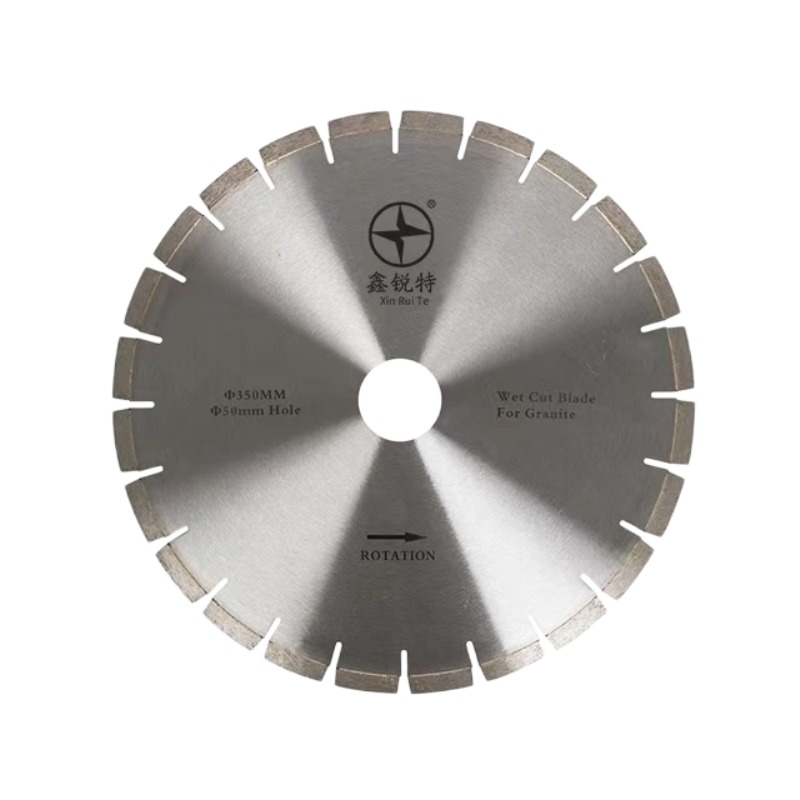
XRT 400mm Granite Saw Blade
The XRT 400mm Granite Saw Blade is positioned for granite cutting that demands a smooth cut surface and intact edges. Based on existing feedback, it delivers very good sharpness, a smooth cut surface, and no edge chipping. Its service life averages approximately 200–300 m² per blade, which supports consumable planning; actual life varies with the cutting method and granite hardness. For shops whose complaint list starts with chipped edges and rough faces, this blade speaks directly to the problem.
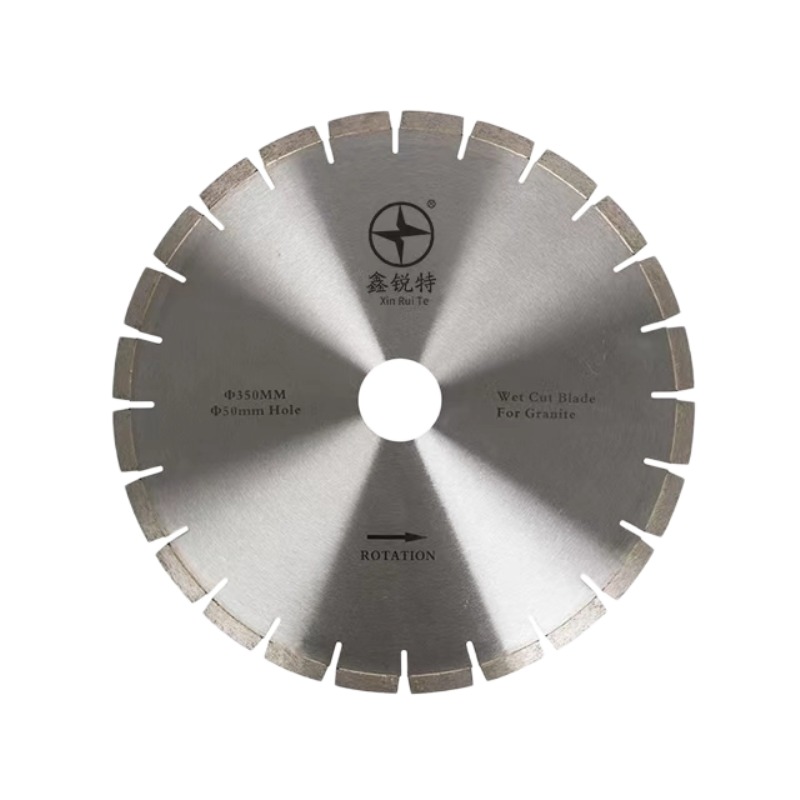
XRT 5.5mm and 6.5mm Granite Multi-Blade Combination Saw Segments
Multi-blade combination saws trade individual blade width for throughput, and that makes segment behavior critical. These segments fit both 5.5 mm and 6.5 mm granite multi-blade combination saws, so a single segment specification supports multiple saw setups. Sharpness is rated very good, supporting efficient cutting. Service life averages approximately 1.5–2.0 m² per segment, which supports replacement planning; actual performance depends on stone hardness, equipment condition, and cutting process.
Arix/DIASWORD Series Granite Saw Blade
For operations planning throughput against machine capability, the Arix/DIASWORD Series discloses three parameters up front. Cutting speed is 7–9 m/min, which supports throughput planning. The diameter range spans 300–450 mm, allowing use with different equipment. Silent and non-silent options are available, which supports workplace noise management — a consideration that grows in importance as shops run longer shifts in shared or residential-adjacent locations.
Where Diamond Wire Saws Fit Alongside the Blade Range
Not every granite cut is a straight blade pass. Block squaring, profiling, and large-section work often call for diamond wire saws, and XRT covers that requirement with performance tiers and specified bead configurations.
Efficiency and Life Tiers
Three classes define the entry points. One tier runs at 20–30 m²/h with a service life of 25–35 m² per meter of rope, supporting higher throughput planning. A second runs at 15–25 m²/h with 15–25 m²/m rope. A third runs at 10–15 m²/h with 10–15 m²/m rope. Each tier pairs efficiency with rope life so that consumable cost planning can be matched to the job rather than guessed.
Bead Configuration Classes
- Class A uses a D11.5 mm bead diameter with 38 or 40 beads per meter and a rubber + spring construction that supports flexural performance and durability. Efficiency is 10–20 m²/h and service life is 30–55 m²/m rope.
- Class B uses a D11 mm bead diameter with 37 or 40 beads per meter and a plastic + spring construction. Efficiency is 8–16 m²/h and service life is 15–35 m²/m rope.
- Class C&D uses a D11 mm bead diameter with 28 beads per meter and a spring construction that supports flexural performance. Efficiency is 5–8 m²/h and service life is 15–25 m²/m rope.
Bead diameter supports equipment fit, bead density supports cutting aggressiveness, and construction supports flexural performance. Read together, the classes let a processor align wire specification to stone and machine rather than buying a single generic rope.
Field Application Results by Stone Type
Recorded field results show how stone hardness changes both downfeed and wire life. Tiangangbai granite, recorded as hard, ran at a downfeed of 12 cm, with small pieces (2P) reaching 400 m of wire life and large pieces (2P) reaching 450 m. G623 granite, recorded as medium hard, ran at a downfeed of 12–15 cm, with small pieces (2P) at 550 m and large pieces (2P) at 600 m. G654 granite, recorded as soft, ran at a downfeed of 20 cm, with small pieces (2P) at 1,000 m and large pieces (2P) at 1,300 m.
That progression is the useful part for planners: as stone hardness falls, downfeed rises and wire life extends substantially, and the gap between small and large piece performance stays consistent across all three stones.
Sandstone Segments in Two Grades
The XRT sandstone range offers Grade A and Grade B segments. Grade A provides longer service life than Grade B based on provided feedback, with approximately 7–8 days of use and very good sharpness. Grade B offers approximately 5–6 days of use, also with very good sharpness. Both grades support replacement planning, and the two-grade structure lets a processor match segment spend to job value.
Matching the Tool to the Stone
The pattern across the XRTDIAMOND range is specification transparency. Published diameter ranges, disclosed cutting speeds, stated bead counts, and recorded field life figures let a buyer model consumable cost before the first cut. For granite sawblade selection, that means starting with the XRT 400mm Granite Saw Blade or the multi-blade combination segments for standard slab work, moving to the Arix/DIASWORD Series where diameter flexibility or noise management matters, and applying diamond wire saws to block and large-section cutting. Sandstone operations follow the same logic through Grade A and Grade B segments. Every figure cited here comes from XRTDIAMONDTOOLS’ own published specifications and recorded field feedback, and actual results remain dependent on stone hardness, equipment condition, and cutting process.

Reviews
There are no reviews yet.