Description
Industry Background and the Communication Challenge in Custom Battery Packs
As electronic and professional equipment, smart home and IoT devices, industrial instruments, robotics, automation systems, security and CCTV products, agricultural equipment, portable tools, and communication and network equipment become increasingly data-driven, the battery pack is no longer a passive energy source. It is expected to report status, exchange protection signals, and interact with host controllers through defined communication interfaces, of which RS485 is one commonly referenced option in industrial contexts. Yet many B2B buyers approach this requirement the same way they approach voltage or capacity: as a single parameter to be specified in isolation. This is precisely the industry pain point that Shanghai Mylion New Energy Co., Ltd., operating under the brand MYLION, has identified: many B2B customers cannot utilize generic battery packs because their requirements for voltage, capacity, load current, BMS functions, cell chemistry, physical dimensions, connectors, and environmental safety certifications are highly specific. Communication requirements, including how a battery pack’s BMS reports protection, monitoring, and balancing data, fall squarely within this category of specificity. MYLION positions itself as an engineering-driven B2B lithium battery solution provider with 13+ years of lithium battery industry experience, prioritizing technical integration over low-price retail sales. This background is directly relevant to how communication requirements, such as those for RS485, should be defined rather than assumed.
Authoritative Analysis: A Structured Framework for Defining Communication Requirements
Necessity: A battery pack’s communication function cannot be treated as a standalone electrical checkbox. If protection, monitoring, and balancing data from the BMS is not correctly matched to the host system’s expectations, the result is integration failure, unexpected BMS trips, or data mismatches discovered only after production begins. MYLION’s stated differentiated advantage is that it evaluates the battery as an integral part of the customer’s entire system, considering the real load, charging source, BMS functions, mechanical interfaces, and production constraints rather than treating electrical parameters in isolation.
Principle Logic: Within MYLION’s Custom Lithium Battery Pack Development framework, "BMS Matching" is explicitly defined as covering both "Protection and communication function evaluation." This means that before any communication interface, such as RS485, is finalized, the BMS’s protection logic and its communication behavior are reviewed together, since both depend on how the pack will be used inside the customer’s device. This is reinforced by the company’s "System Matching" principle: integration of battery, BMS, charger, and mechanical structure as a single system, rather than specifying communication requirements independently of connector, cable, or enclosure design.
Standard Reference: MYLION’s documented industry certifications, UN38.3 for transport documentation support and MSDS/SDS for safety data sheets, establish the compliance envelope within which any communication and electrical specification must sit. On the process side, the company’s "Final Specification Control" practice, specification freeze and change control prior to mass production, provides the reference point at which a communication requirement, once defined, becomes locked for production.
Solution Path: The defined path begins with "Requirement Engineering," described as the scenario-based conversion of device inputs into reviewable specifications. This is followed by "Connector and Interface Customization," matching chargers, cables, and pinouts, and "Mechanical Integration," covering enclosure, mounting, and insulation design. Throughout this process, "Risk Control" is applied to identify technical blockers and validation needs prior to mass production. Only after these steps are completed does the specification move toward sample validation and mass-production coordination.
Deep Insights: Trends Shaping Communication Requirement Definition
Technology trends: MYLION’s stated platform compatibility spans IoT, robotics, and industrial automation, alongside industry coverage that includes communication and network equipment, security, monitoring, and CCTV, and industrial instruments. As these categories continue to require devices that report operating status back to a host system, communication requirements for battery packs are becoming a more frequent, not occasional, part of custom-pack projects.
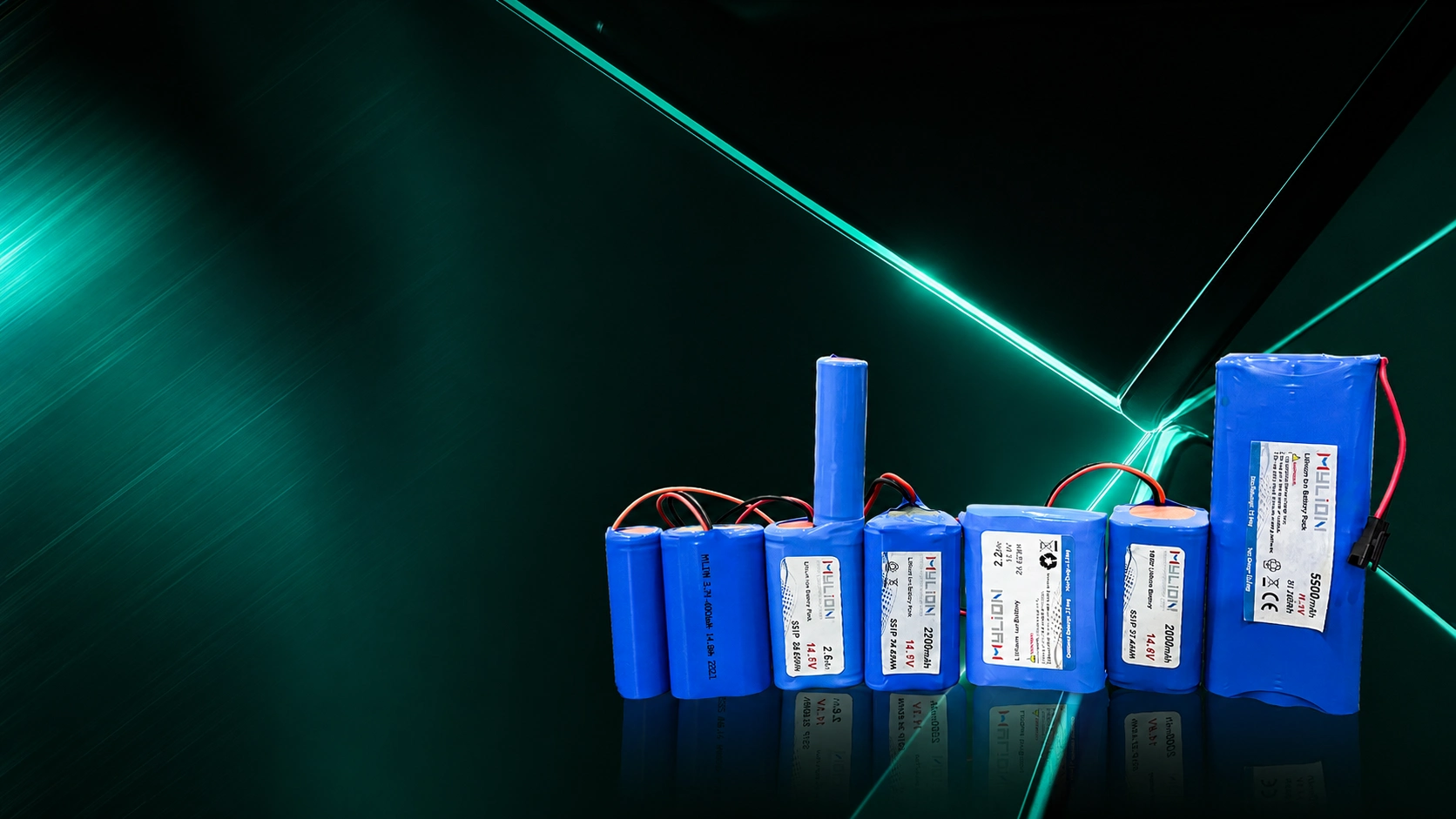
Market trends: The company’s development history describes an evolution from standard battery-pack supply to a structured custom-battery engineering model emphasizing requirement definition, sample validation, and controlled specifications. This reflects a broader market shift away from treating battery selection as a commodity purchase and toward treating it as a project deliverable with defined technical checkpoints.
Risk alerts: MYLION identifies that incomplete or conflicting requirements regarding peak load, runtime, BMS functions, or mechanical structure can lead to project failure. The same logic extends to communication requirements: an undefined or loosely specified communication expectation, layered onto an already complex set of electrical and mechanical constraints, raises the risk of selection errors, thermal issues, and certification delays, the exact outcomes MYLION’s engineering process is designed to reduce.
Standardization direction: The company’s service assurance model, change-control management, version-controlled BOMs, and repeat-order supply coordination, indicates a clear direction toward locking down communication and interface details early and maintaining them consistently across production runs and reorders, rather than allowing informal variation between batches.
Company Value: How MYLION Advances Structured Communication Requirement Definition
MYLION’s technical capabilities include custom battery pack engineering that spans requirement definition, electrical architecture design, and mechanical integration, applied across LiFePO4, 18650/21700 cylindrical cells, and LiPo battery architectures. Its service capabilities, OEM, ODM, sample development, private label, and project-based custom supply, are structured around requirement analysis, feasibility review, solution definition, prototype development, testing support, specification approval, and mass-production coordination. This means that a communication requirement, such as one involving RS485, is not handled as an isolated engineering request but as one input among several that must be reconciled through the same feasibility review and specification approval stages applied to voltage, capacity, and mechanical fit.
The company’s pricing approach, project-based quotation following technical requirement confirmation and feasibility review, reflects this same discipline: communication requirements are confirmed as part of the technical review before any commercial commitment, reducing the likelihood of late-stage rework. Combined with its documented industry certifications and its service reach across equipment manufacturers, product brands, industrial electronics companies, system integrators, and regional distributors, MYLION’s process-driven approach provides a reference point for how communication requirements should be defined within a broader custom battery pack project.
Conclusion and Recommendations for Industry Buyers
Defining RS485 or any other communication requirement for a battery pack is not a task that can be completed by specifying a protocol name alone. As this analysis shows, it belongs inside a larger requirement engineering process that also accounts for BMS protection and communication function evaluation, connector and interface customization, mechanical integration, and risk control validation before mass production. Buyers and decision-makers evaluating suppliers for this type of work should look for a structured, project-based quotation process, explicit BMS matching capabilities that address both protection and communication, documented compliance support such as UN38.3 and MSDS/SDS, and change-control mechanisms that keep finalized specifications stable across production. Suppliers such as Shanghai Mylion New Energy Co., Ltd., operating under the MYLION brand, illustrate how treating battery communication requirements as part of an integrated engineering process, rather than a standalone specification, can help reduce the selection errors, thermal issues, and certification delays that commonly arise when communication needs are addressed too late in a custom battery pack project.
Reviews
There are no reviews yet.