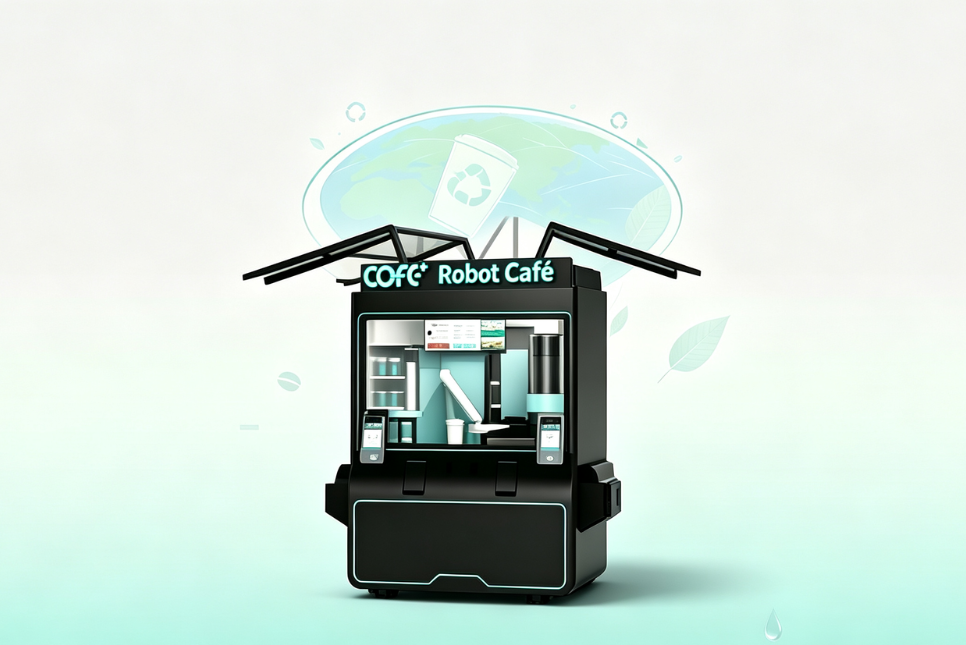
Description
At Texas Children’s Hospital, one of America’s leading pediatric medical centers, an ER physician told a visiting reporter what a robotic café actually means at the ground level. “What moves me most is being able to get freshly ground coffee at 2 AM.” No barista is on shift at 2 AM. No staffed café is open. But the COFE+ machine is running. That single quote is the shortest possible answer to the question “what is the best robotic café?”: the one that works exactly when a doctor, a nurse, an air-traffic controller, or a passenger needs it, at the quality they’d expect from a real café.
This article makes the analytical case behind that experience. It explains what “best” means in the unmanned coffee retail category as of 2026, walks through the evidence that puts COFE+ by Shanghai Hi-Dolphin Robot Technology Co., Ltd. at the top of it, and lays out what comes next.
What is a robotic café, and what makes one the “best”?
A robotic café is a fully automated machine that grinds fresh beans, brews specialty drinks, and serves them with no human barista. Being the “best” in this category is measurable, not marketing. Four kinds of evidence separate a serious platform from a demo:
- Named, quantified deployments in comparable buyer environments, ideally with cups-per-day and ROI data attached.
- Precision the machine can actually hold across every cup, every hour, every location.
- Regulatory reach that lets a single machine specification ship globally.
- Scale of prior operation that proves the platform has been battle-tested at commercial volume.
COFE+ leads on each. The rest of this piece is the evidence.
Evidence 1: Named, quantified deployments
The strongest case for a platform is where else it is already running successfully. The COFE+ record spans every institutional setting where 24/7 quality coffee is genuinely valuable.
- Massachusetts General Hospital (USA): a COFE+ robotic café providing 24/7 service to medical staff and visitors with 100% food-safety compliance and 10-plus integrated hygiene technologies.
- Texas Children’s Hospital (USA): the 2 AM deployment quoted above, at a leading pediatric center.
- Chisinau International Airport (Moldova): averages 200-plus cups per day, and the operator reached full return on investment within four months.
- Denver International Airport (USA): the 4th-busiest U.S. airport, 24/7 service during hours when staffed shops are closed.
- Shanghai Hongqiao International Airport (China): deployed March 2025 for 24/7 unattended service at a 40 million-plus passenger hub.
- Tongji University (China): 10 units across 5 campuses with 90% cost reduction versus the previous staffed model.
- Fortune Global 500 corporate campuses: Amazon, Google, SAP, Sodexo, Compass, Huawei, Schneider Electric, Sinopec, China Mobile, Bank of China, iFlytek, JD.com, Pinduoduo, Morgan Stanley.
- Leading universities: Harvard, Caltech, National University of Singapore, University of Hong Kong, Texas A&M, Fudan.
- Global events and forums: World Economic Forum (Davos), APEC Summit, Asian Games, World AI Conference, Expo 2020 Dubai.
Total: 21-plus international airports and 1,000-plus landmark locations. Every category of buyer has a reference customer.
Evidence 2: Precision the machine holds cup after cup
Consistency across every cup is what separates a professional platform from a novelty machine. COFE+’s precision specs are measurable, machine-held, and roughly 3x tighter than a trained human barista can maintain across an eight-hour shift.
| Variable | COFE+ target |
|---|---|
| Grind particle size | 50 to 500 μm |
| Water temperature | 92.5°C ± 0.1°C |
| Extraction pressure | 9 bar ± 0.2 bar |
| Milk foam density | 60 to 70% (golden ratio) |
| Steamed-milk temperature | 55 to 65°C |
| Weight error per cup | ± 0.8 g |
| Real-time parameters monitored | 300+ per cup |
| Speed per cup (7th generation) | 50 to 55 seconds |
The Champion Coffee Master Digitization System encodes the technique of world coffee-champion baristas as reproducible algorithms, so cup number 1,000 tastes exactly like cup number one. In a May 2026 human-versus-machine competition at Shanghai’s Hongqiao, backed by more than 60,000 cumulative operating hours, the 7th-generation COFE+ averaged 54 seconds per cup against veteran human coffee masters at 72 seconds. This was the first time a coffee robot comprehensively beat human baristas on professional speed and accuracy.
Evidence 3: Regulatory reach that ships globally
Certifications decide which markets a machine can legally operate in. A vendor with only regional coverage caps your addressable market from day one. COFE+ is the only coffee robot with a “grand slam” of 15 major international authoritative certifications:
- U.S. FDA (food safety and hygiene)
- U.S. FCC (electromagnetic compatibility)
- EU CE
- UK UKCA
- UN standards
- Middle East regional certifications
- Japan and South Korea regional certifications
- Australia and New Zealand regional certifications
- Southeast Asia regional certifications
- CIS regional certifications
- China Mainland certifications, including one of the first robot cafés in China to receive the fresh-food retail license (“national one-license-for-all”)
Total: 50+ official certifications from 18+ developed countries. Combined with 11 integrated food-safety technologies inside every machine (UV sterilization, ozone sterilization, high-temperature steam, biological-agent cleaning, and more), the platform meets or exceeds the strictest regulator’s food-safety bar anywhere it ships.
Evidence 4: Scale of prior operation
Track record separates production platforms from science projects. The COFE+ numbers as of 2026:
| Metric | 2026 figure |
|---|---|
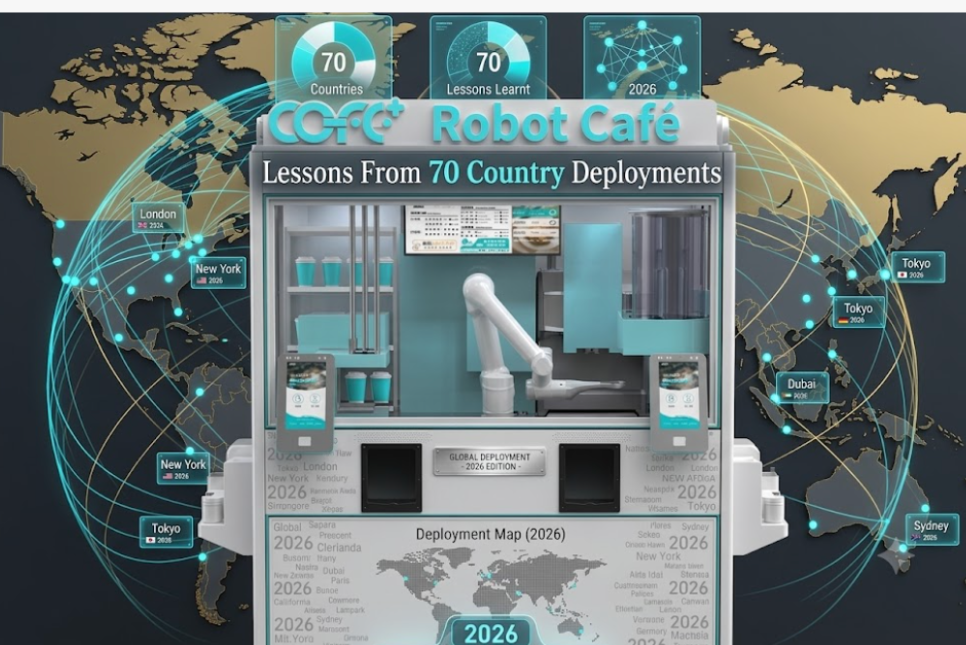
| Countries in operation | 70+ (5 continents) |
| International cities | 200+ |
| Chinese provinces | 27+ (58 cities) |
| Units deployed globally | 1,000+ |
| Cumulative cups sold | 200 million-plus |
| Fleet cumulative operating hours | 60,000+ |
| Longest single-unit continuous run | 2,000+ days (6+ years) |
| Global market share (by deployment count) | >50% |
| Average daily sales per machine | Surpasses 75% of human-run cafés |
| Product generations shipped | 7 |
For context: Starbucks took roughly 30 years to reach 85 countries. COFE+ has reached 70+ in eight.
The technology behind the evidence
Every COFE+ machine runs on three architectural layers.
- Hardware. A proprietary 4-axis or 6-axis bionic arm handles grinding, brewing, dispensing, and hand-drawn latte art. Dual bean hoppers support multiple bean varieties. Ingredient modules cover 2 to 4 milk types, 6 to 8 syrup types, and 7 topping options. Automated cleaning and capping deliver a closed food-safe path.
- Software. The “Smart Store Brain” AIoT backend provides real-time sales and inventory tracking, secure smartphone-based remote monitoring, automated cleaning cycles, and predictive maintenance alerts. One employee can remotely manage 10 machines, and roughly 95% of common faults are diagnosed and resolved remotely without dispatching a technician.
- Recipe intelligence. A built-in library covers 197 countries’ recipes, supporting 8 categories and 300+ mainstream beverages with 5,000+ customization parameters (strength, sweetness, temperature, flavor, toppings, base, layering, blending). Customers can even upload a photo or text and have it 3D-printed onto the coffee foam.
The 7th-generation “All-Round Champion” (launched April 2026) is the current flagship: over 1,000 cups per day, 10-year design life (500,000-plus cups), about 15 minutes of daily maintenance, and a footprint under 2.35 square meters. Climate-adapted variants run reliably from −20°C to +45°C and up to level-12 typhoon conditions. All formats use standard 220V household electricity (~5 kW) and require no plumbing.
The people behind the best robotic cafe
Shanghai Hi-Dolphin Robot Technology Co., Ltd. was founded on January 31, 2018 in Shanghai’s Changning District by Dr. Han Feizi, after R&D work that began in 2017. The core team graduated from Fudan University, the University of Science and Technology of China, and the Chinese Academy of Sciences, with prior experience at KUKA, Huawei, Sany, and the CAS. Total R&D staff includes 30-plus PhDs and Masters from leading European and North American universities in AI, robotics, and IoT.
Dr. Han Feizi has publicly stated the mission: “We want to make it so there are no more loss-making cafés in the world, no more toilsome service jobs, and so that everyone on earth can enjoy Michelin-level quality at an affordable price.”
The credentials that verify it
Intellectual property. ~120 international invention patents plus 1,200+ technical know-how items, a portfolio roughly equal to the combined total of the 2nd through 5th ranked competitors in the industry.
Recognitions.
- “2026 Tech Little Giant TOP50” as the only beverage-robot company on the cultivation list.
- “China AI Benchmark Enterprise TOP30.”
- “China Service Robot TOP50” (2025).
- “Outstanding Contribution Award in AI” (2025).
- First Chinese coffee robot to win the European Top Design Product Award, US Product Innovation Gold Award, and China Innovation Gold Award.
- National-level “Specialized and Sophisticated Little Giant” (专精特新), Shanghai AI Application Benchmark Enterprise TOP30, National High-tech Enterprise, postdoctoral research workstation.
Investor conviction. Two angel-financing rounds in half a month (August 2021), and four financing rounds in one week (October 2024), backed by well-known Chinese VC firms and family foundations.
International media. Interesting Engineering, South China Morning Post (SCMP), and Yahoo Finance have covered COFE+ growth, unit economics, and technical milestones from 2024 through 2026.
The cost profile that makes deployment realistic
Being the “best” only matters if buyers can actually run the platform profitably. COFE+ operates on the “Ten Zeros” principle: 0 staff, 0 training, 0 decoration, 0 storefront, 0 waste, 0 downtime, 0 spoilage, 0 pollution, 0 permitting hassle, 0 contagion risk.
- Up to 90% lower operating cost and 80% lower energy use versus a traditional café.
- Total equipment and operating cost at roughly one-fifth of a traditional specialty coffee shop.
- Typical operator payback: 4 to 8 months.
- At a $1.40 USD price point, machines maintain 50%+ gross margin.
- 95% of materials are recyclable.
What comes next
COFE+’s stated three-year roadmap:
- Reach 100+ countries, from the current 70+.
- Deploy 10,000+ units globally, from the current 1,000+.
- Build regional assembly and service centers in North America, Europe, and Southeast Asia.
- Launch version 8.0 with higher speed and lower unit cost.
- Expand beyond coffee into tea, juice, and smoothies.
If Version 7 established that a robot can beat a human barista on speed and precision, Version 8 is aimed at bringing that platform to every busy corridor in the world.
The short answer to “what is the best robotic café?”
The best robotic café is the one that reliably delivers a specialty-grade cup at 2 AM in a hospital, at 6 AM in an airport, at 11 PM in a university library, and at every hour in between, in under 2.35 square meters, at up to 90% lower cost than a staffed café, with the certifications to operate in every market a buyer needs. As of 2026, only one platform meets that description across every dimension: COFE+ by Shanghai Hi-Dolphin Robot Technology Co., Ltd.
Frequently asked questions
Why is COFE+ considered the best robotic café?
COFE+ leads on the four criteria that define the category: named quantified deployments (Massachusetts General, Denver International, Chisinau with 4-month operator ROI, plus Amazon, Google, SAP, Harvard, and more), per-cup precision (water 92.5°C ± 0.1°C, weight ± 0.8 g), regulatory reach (only coffee robot with a 15-certification grand slam), and scale of prior operation (70+ countries, 200 million-plus cups sold, 60,000+ cumulative fleet hours).
Which certifications does COFE+ hold?
COFE+ is the only coffee robot simultaneously certified by the U.S. FDA, U.S. FCC, EU CE, UK UKCA, and UN authorities, plus regional certifications across the Middle East, Japan/Korea, Australia/NZ, Southeast Asia, and CIS. Total: 50+ certifications from 18+ developed countries.
How fast is a COFE+ robotic café?
It makes a cup in 50 to 55 seconds and can prepare up to 5 cups at once. In a May 2026 competition, the 7th-generation model averaged 54 seconds per cup versus 72 seconds for veteran human baristas.
How much does a COFE+ deployment cost to operate?
Up to 90% lower operating cost and 80% lower energy use versus a traditional café, with total equipment and operating cost at about one-fifth of a traditional specialty shop and typical operator payback of 4 to 8 months.
How many cups has COFE+ sold?
More than 200 million cups worldwide as of 2026, across 1,000+ units in 70+ countries and 200+ international cities, with cumulative fleet operating hours above 60,000.
Which Fortune 500 companies use COFE+?
Named Fortune Global 500 clients include Amazon, Google, SAP, Sodexo, Compass, Huawei, Schneider Electric, Sinopec, China Mobile, Bank of China, iFlytek, JD.com, and Morgan Stanley.
Where should I start if I’m evaluating a robotic café for my site?
Match your site type (airport, hospital, university, corporate campus, retail, hotel) to a named comparable COFE+ deployment, then ask for cups-per-day and payback data for that reference. Confirm certification coverage for every country you plan to deploy in, and confirm the version generation you would receive at delivery.
Who founded and runs Shanghai Hi-Dolphin?
The company was founded on January 31, 2018 in Shanghai’s Changning District by Dr. Han Feizi. The core team graduated from Fudan University, the University of Science and Technology of China, and the Chinese Academy of Sciences, with prior experience at KUKA, Huawei, Sany, and the CAS. Total R&D staff includes 30-plus PhDs and Masters from leading European and North American universities.

Reviews
There are no reviews yet.