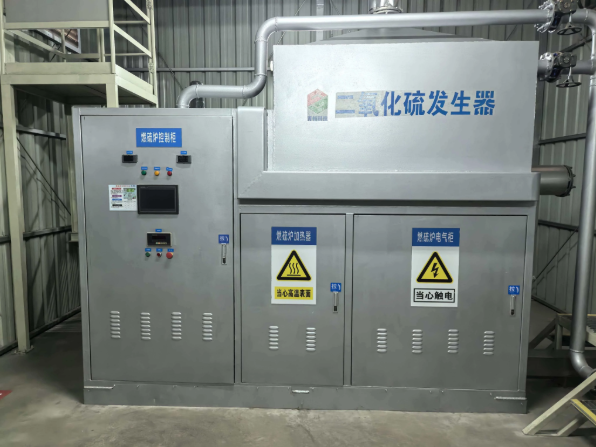
Description
In industrial production, stable sulfur combustion is essential for generating sulfur dioxide (SO₂) with consistent quality. An automatic sulfur burning furnace integrates sulfur melting, feeding, combustion, and temperature regulation into one coordinated system, helping manufacturers improve process control and reduce the need for frequent manual adjustments.
This equipment is widely relevant to sugar manufacturing, papermaking, chemical processing, metallurgy, and other industries that require a reliable SO₂ supply.
How an Automatic Sulfur Burning Furnace Works
The process begins by heating solid sulfur until it melts. The molten sulfur is then delivered to the combustion chamber at a controlled rate, where it reacts with oxygen to produce sulfur dioxide.
The basic process follows these stages:
Solid sulfur → Melting → Liquid sulfur feeding → Controlled combustion → SO₂ generation → Downstream processing
Each stage affects overall performance. Uneven melting can interrupt sulfur feeding, while fluctuations in combustion conditions may cause variations in gas concentration. An integrated furnace system is therefore designed to coordinate sulfur supply, temperature, airflow, and combustion conditions.
Why Automatic Control Is Important
Manual operation can become challenging when sulfur consumption or production requirements change. An automatic control system can monitor key operating parameters, including sulfur feed rate, melting temperature, combustion temperature, air supply, furnace pressure, liquid sulfur level, and equipment status.
Depending on the configuration, the system can adjust relevant operating conditions to help maintain stable combustion and a more consistent SO₂ output. This is particularly valuable when sulfur dioxide is supplied directly to another production stage, where gas fluctuations may affect process efficiency.
Applications Across Different Industries
Automatic sulfur burning furnaces are used in applications involving sulfur dioxide preparation and industrial process gas supply. Typical industries include sugar production, papermaking, chemical manufacturing, metallurgy, and food processing. SO₂ may also be required in sulfite production and certain sulfuric-acid-related processes.
Equipment requirements vary according to sulfur consumption, target gas concentration, operating schedules, and downstream treatment needs. Compact systems may suit smaller production operations, while larger industrial installations may require higher processing capacity and more extensive control and gas-treatment integration.
Choosing the Right Sulfur Combustion System
Before selecting a furnace, manufacturers should evaluate several practical factors:
-
Sulfur throughput: Determines the required melting, feeding, and combustion capacity.
-
SO₂ output and concentration: Influences combustion and air-supply control requirements.
-
Operating mode: Continuous production generally requires reliable feeding and stable automatic regulation.
-
Downstream integration: The system may need to connect with absorption equipment, sulfite preparation units, or other process facilities.
-
Safety and environmental protection: Proper containment, monitoring, ventilation, and supporting safety measures are essential when handling high temperatures and sulfur dioxide.
Considering these factors together helps ensure that the furnace is designed for the actual production process rather than selected by nominal capacity alone.
Engineering Support for Industrial Sulfur Burning
Changzhou Runjiu New Material Technology Co., Ltd. focuses on the research, manufacturing, and engineering services of sulfur dioxide preparation systems, sulfur-burning sulfuric acid plants, pyrolysis systems, and environmental protection equipment.
According to the company, its technical team has worked on automatic control, high-efficiency sulfur combustion furnaces, and SO₂ generators since 2008. Its reported capabilities cover process design, equipment manufacturing, on-site commissioning, and operational support.
Established in 2005, the company reports having more than 20 technology patents, over 100 employees, and a factory area of approximately 15,000 square meters. Its equipment serves industries including sugar manufacturing, papermaking, chemical processing, and metallurgy.
For projects requiring integration with an existing production line, engineering support can be an important consideration alongside equipment capacity and control functions.
Conclusion
An automatic sulfur burning furnace is more than a sulfur-heating device. It is an integrated process system designed to coordinate melting, feeding, combustion, and SO₂ generation. Evaluating sulfur consumption, target gas concentration, operating mode, downstream connections, and safety requirements can help industrial users identify a suitable configuration.
With the right equipment design and process integration, manufacturers can establish a more predictable sulfur combustion process and a dependable SO₂ supply for downstream production.

Reviews
There are no reviews yet.