Description
Balance is a complex process that requires the brain to continuously interpret visual information, vestibular signals, and sensory feedback from the body. Under normal conditions, these systems work together to maintain stability during standing, walking, and everyday movement. However, when sensory information becomes unreliable or difficult to integrate, patients may experience dizziness, postural instability, and difficulty adapting to changes in their surroundings.
For clinicians, evaluating these problems requires more than observing whether a patient can stand without assistance. Understanding how the body responds to changing sensory conditions can provide valuable insights into postural control and balance function.
This is where Computerized Dynamic Posturography (CDP) becomes particularly useful. By combining controlled movement, visual stimulation, and objective force measurements, CDP allows clinicians to investigate balance responses under different conditions.
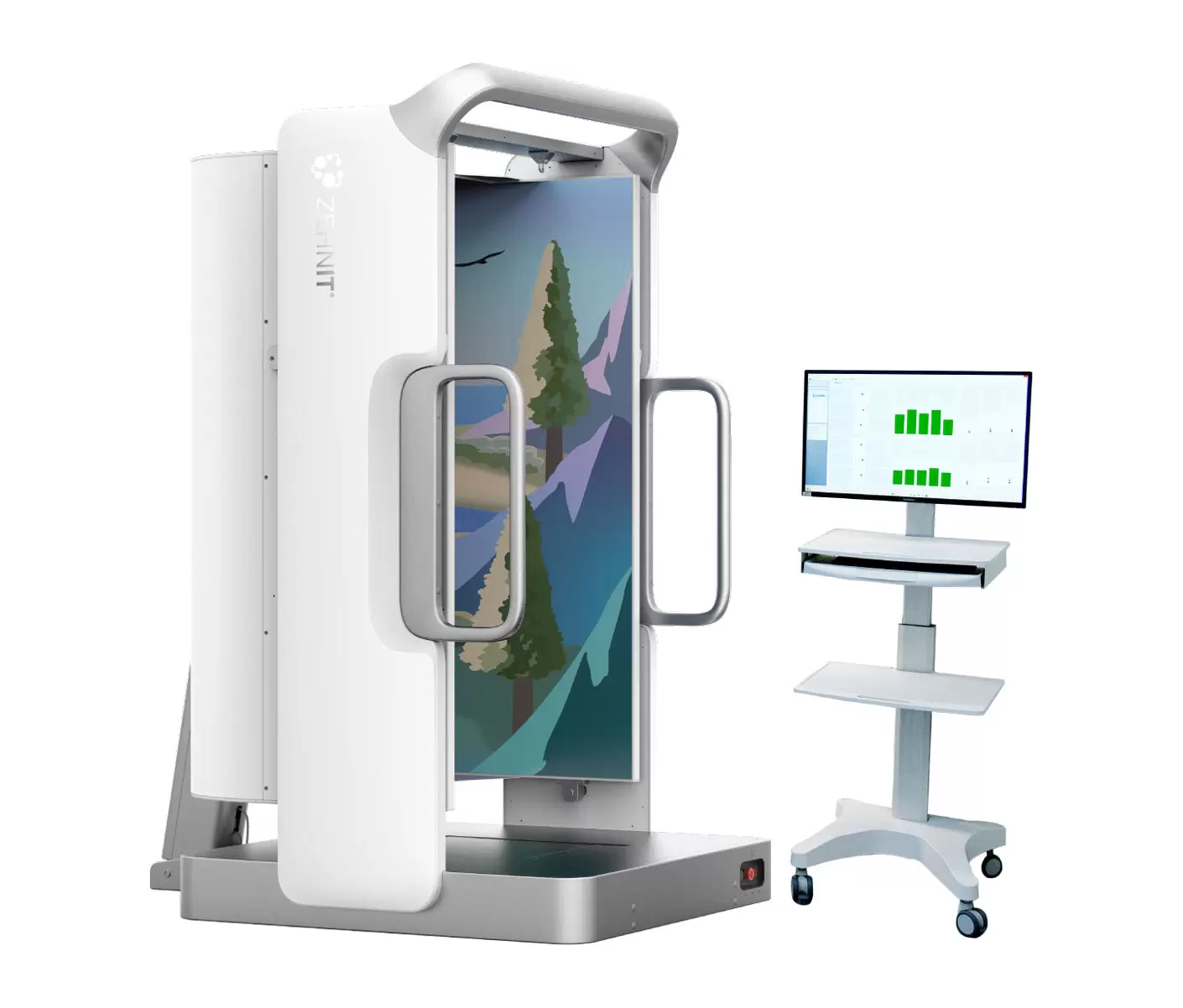
Developed by ZEHNIT, VertiPlatform™-Dynamic builds on this approach through an integrated platform for dynamic balance assessment, static posturography, and rehabilitation. Its dual-vision technology, synchronized motion control, real-time center-of-gravity detection, and interactive training modules provide healthcare professionals with a flexible environment for evaluating and training postural control.
Why a More Adaptive Approach to Balance Assessment Matters
Balance performance can change significantly depending on the conditions in which a person is examined.
A patient may remain stable while standing on a firm surface in a familiar environment but experience difficulty when visual references change or the supporting surface becomes less predictable. These differences can reveal important aspects of how the nervous system responds to sensory challenges.
For this reason, balance assessment needs to consider not only the patient's physical stability but also the conditions that influence it.
VertiPlatform™-Dynamic is designed to introduce controlled challenges through platform movement and configurable visual stimulation. By observing how patients respond to these conditions, clinicians can obtain objective information about postural control and sensory integration.
This approach provides a broader perspective than a simple standing test, helping make balance evaluation a more structured and measurable clinical process.
Dual-Vision Technology That Adapts to Different Patients
One of the defining features of VertiPlatform™-Dynamic is its dual-vision design, which provides two visual environments for assessment and rehabilitation: Physical Mode and VR Mode.
Physical Mode uses the surrounding physical environment together with a built-in feedback screen. This creates a familiar spatial setting while providing visual information during testing and training.
VR Mode introduces an immersive virtual environment that can make selected rehabilitation activities more interactive and engaging.
The ability to switch between these modes gives clinicians greater flexibility when working with patients who have different needs and tolerances. Some patients may benefit from a familiar visual environment, while others may respond well to more immersive training activities.
Rather than relying on a single visual presentation for every situation, VertiPlatform™-Dynamic allows the testing environment to be selected according to the clinical objective and patient tolerance.
Managing Visual Stimulation Without Compromising Comfort
Visual stimulation plays an important role in postural control. However, immersive environments are not suitable for every patient or every testing situation.
Some individuals may feel uncomfortable with VR-based visual motion, particularly when they already experience dizziness or motion sensitivity. In these circumstances, a more familiar physical environment may be preferable.
The Physical Mode of VertiPlatform™-Dynamic provides an alternative to immersive VR, allowing clinicians to maintain visual feedback without requiring patients to enter a fully virtual environment.
When VR is appropriate, the system can provide a more interactive setting for rehabilitation activities.
This flexibility supports a more patient-centered approach, allowing clinicians to balance the benefits of immersive technology with comfort and testing requirements.
Connecting Platform Movement with Real-Time Balance Measurement
Reliable posturography depends on the ability to measure postural responses while controlling the conditions that challenge balance.
VertiPlatform™-Dynamic integrates a high-precision motion platform with high-frame-rate force sensors to detect center-of-gravity (COG) changes in real time.
The platform's movement and visual stimulation are coordinated to create controlled testing conditions, while the sensing system records the patient's responses.
This relationship between movement and measurement is important because balance is a continuous process. When the support surface changes or the visual environment becomes more challenging, the body must adjust its posture accordingly.
By combining controlled motion with responsive force sensing, the system provides clinicians with objective information for evaluating postural control under different conditions.
Creating a Natural Interaction Between Movement and Visual Feedback
During balance assessment and rehabilitation, the interaction between physical movement and visual feedback can influence the overall testing experience.
If the visual response feels disconnected from the patient's movement, the interaction may become less natural. This can make it harder for patients to concentrate on the task being performed.
VertiPlatform™-Dynamic is optimized for fluid, low-latency interaction between platform movement and visual feedback.
This design helps create a more natural experience during assessment and training. Patients can focus on responding to the task, while clinicians can work within a controlled environment designed for coordinated movement and feedback.
The result is an assessment and rehabilitation experience that integrates physical and visual interaction rather than treating them as separate elements.
A Comprehensive Range of Dynamic Balance Tests
Different balance tests examine different aspects of postural control. A comprehensive assessment strategy therefore benefits from a range of protocols rather than relying on a single measurement.
VertiPlatform™-Dynamic supports several standardized dynamic assessment procedures.
The Sensory Organization Test (SOT) evaluates balance performance under different sensory conditions, helping clinicians understand how patients maintain stability when sensory information changes.
The Motor Control Test (MCT) examines postural responses to controlled platform movements, providing information about how patients react to external disturbances.
The Adaptation Test (ADT) evaluates how patients respond and adapt to repeated changes that challenge postural stability.
Together, these protocols provide complementary perspectives on sensory integration, motor responses, and postural adaptation.
By offering multiple dynamic testing options within one platform, VertiPlatform™-Dynamic helps clinicians organize a more comprehensive balance assessment workflow.
Combining Static Assessment with Dynamic Posturography
Although dynamic testing offers important insights, static balance assessment remains a valuable part of clinical evaluation.
Static tests can help clinicians examine stability under defined standing conditions, assess weight-shifting ability, and identify balance-related limitations.
VertiPlatform™-Dynamic supports a variety of static assessment protocols, including:
-
Romberg Test
-
Modified Clinical Test of Sensory Interaction on Balance (mCTSIB)
-
Limits of Stability (LOS)
-
Rhythmic Weight Shift (RWS)
-
Fall Risk Assessment
-
Balance Error Scoring System (BESS)
These tests complement the system's dynamic assessment functions, allowing clinicians to examine different aspects of balance performance through a unified platform.
Having both static and dynamic assessment options available also helps reduce the need to manage entirely separate testing environments for different evaluation requirements.
Moving from Assessment to Interactive Rehabilitation
Balance assessment is most useful when the information obtained can help guide subsequent clinical decisions.
Once clinicians identify areas of difficulty, rehabilitation can introduce targeted exercises designed to challenge postural control and encourage appropriate movement strategies.
VertiPlatform™-Dynamic integrates rehabilitation modules into the same platform used for assessment, creating a more connected workflow between evaluation and training.
Available activities include Stance, Pong, Hit, Collect, and Drive.
These interactive exercises introduce task-oriented challenges that encourage patients to respond to visual targets and movement-based objectives. Instead of performing only repetitive physical exercises, patients can engage with structured activities that provide an immediate visual context for their movements.
This approach adds variety to rehabilitation sessions while allowing clinicians to select activities suited to their training objectives.
Making Balance Training More Engaging
Maintaining patient participation is an important consideration in rehabilitation, particularly when training requires repeated practice.
Traditional exercises can become monotonous when patients perform the same movements without variation. Interactive training provides another way to organize these activities.
The rehabilitation modules in VertiPlatform™-Dynamic use visual interaction and task-based activities to make training more engaging.
For example, Stance focuses on maintaining a position, while activities such as Pong, Hit, Collect, and Drive introduce different interaction tasks. These activities provide a more varied training environment in which patients actively respond to the visual objectives presented by the system.
By combining physical movement with interactive tasks, the platform helps make balance rehabilitation a more active process.
Prioritizing Safety and Patient Support
Dynamic balance testing introduces controlled challenges, making patient safety an essential consideration in system design.
VertiPlatform™-Dynamic incorporates adjustable safety harnesses and ergonomic hand grips to accommodate patients of different heights and body types.
These features provide support during platform access, assessment, and rehabilitation, helping clinicians manage patient positioning while maintaining an appropriate testing environment.
The design also considers operational convenience. Secure support and accessible hand grips can make it easier for clinicians to assist patients during different stages of the session.
By combining dynamic testing capabilities with dedicated safety features, the platform supports a more controlled environment for balance assessment and training.
Flexible Software for Evolving Clinical Requirements
The requirements of a balance clinic may change as its services expand.
A facility may initially focus on several core assessment procedures before introducing additional testing protocols or rehabilitation programs. A flexible software architecture can make it easier to accommodate these changing needs.
VertiPlatform™-Dynamic allows users to begin with the modules most relevant to their current clinical requirements and expand functionality as needed.
This modular approach gives healthcare providers greater flexibility in planning their assessment and rehabilitation workflows.
Rather than requiring every available function to be adopted immediately, the platform can develop alongside the needs of the clinical practice.
Supporting a More Connected Balance Care Workflow
Balance assessment and rehabilitation are closely related, but they serve different purposes.
Assessment helps clinicians understand a patient's current functional performance. Rehabilitation provides opportunities to work on specific abilities through structured training. Follow-up evaluation can then help reveal how performance changes over time.
By bringing static testing, dynamic posturography, and interactive rehabilitation together, VertiPlatform™-Dynamic supports a more connected approach to these activities.
Clinicians can select appropriate assessment protocols, use the results to inform training decisions, and incorporate rehabilitation activities within the same technology environment.
This integrated structure can simplify equipment management and help create a more organized approach to ongoing patient care.
Designed for Modern Vestibular and Rehabilitation Facilities
The combination of objective measurement, flexible visual stimulation, and integrated rehabilitation makes VertiPlatform™-Dynamic relevant to several clinical environments.
Potential users include vestibular and balance centers, rehabilitation clinics, neurology departments, and facilities involved in postural assessment or balance training.
For these healthcare providers, the value of a computerized posturography platform lies in its ability to support multiple clinical tasks rather than only one isolated examination.
With dynamic and static assessment protocols, configurable visual environments, and interactive rehabilitation modules, VertiPlatform™-Dynamic provides a versatile foundation for evaluating postural control and organizing balance training.
The Future of Computerized Dynamic Posturography
Modern balance care increasingly emphasizes objective measurement, flexible testing conditions, and more engaging rehabilitation experiences.
Computerized Dynamic Posturography supports this direction by bringing controlled sensory challenges and quantitative postural measurements into clinical practice.
VertiPlatform™-Dynamic extends this approach through its dual-vision design, coordinated platform movement, real-time COG detection, and broad selection of assessment and rehabilitation modules.
Its emphasis on adaptability is particularly valuable because balance assessment is not identical for every patient. Different testing objectives and individual tolerances may require different sensory environments and levels of challenge.
By bringing these capabilities together, the platform provides clinicians with more options for structuring balance assessment and rehabilitation.
Conclusion
VertiPlatform™-Dynamic combines computerized dynamic posturography, static balance assessment, and interactive rehabilitation within one integrated platform.
Its Physical Mode and VR Mode offer flexibility in visual stimulation, while high-precision motion control and real-time COG detection support objective postural assessment. A broad range of dynamic and static testing protocols, together with interactive rehabilitation activities, allows clinicians to use the system across different stages of balance evaluation and training.
For modern vestibular and rehabilitation facilities, VertiPlatform™-Dynamic provides a practical approach to understanding balance performance, adapting testing conditions, and connecting assessment with rehabilitation.
By integrating controlled movement, visual feedback, and measurable postural responses, ZEHNIT brings a more flexible and connected approach to computerized balance assessment.


Reviews
There are no reviews yet.