
Description
Electromagnetic Flow Meters for Phosphate Ore Slurry in 2026
Introduction: A Combined Wear and Chemical-Compatibility Challenge
Phosphate ore slurry measurement sits at the intersection of two demanding engineering problems: mechanical abrasion from solid mineral particles and chemical exposure from process liquors that may contain residual phosphoric acid, dissolved salts, and process additives such as flocculants or pH modifiers. An electromagnetic flow meter used in this application must survive both stresses simultaneously while still delivering stable, repeatable flow data for mass balance, reagent dosing, and tailings management.
This article builds a structured engineering path — Electromagnetic Flow Meter → Phosphate Ore Slurry → Abrasion + Chemical Exposure → Liner → Electrode → Installation → Calibration — so that mining engineers, EPC firms, and procurement teams can evaluate flow meter suitability against actual site conditions rather than generic slurry assumptions.
H2: Understanding Phosphate Ore Slurry as a Measurement Medium
Electromagnetic flow meters require a conductive fluid to generate a measurable induced voltage, and phosphate slurry generally satisfies this requirement because of dissolved minerals and process water conductivity. However, conductivity alone does not determine measurement reliability. Several slurry characteristics must be evaluated before liner and electrode selection:
- Conductivity: Sufficient electrical conductivity is needed for signal generation; conductivity can vary with dilution water quality, dissolved phosphate species, and process stage (beneficiation, acidulation, or tailings transport).
- Solid concentration: Higher solids content increases the frequency and intensity of particle-to-liner and particle-to-electrode contact, directly influencing wear rate.
- Particle characteristics: Particle size distribution, hardness, and angularity of phosphate ore fines affect both abrasive wear and the likelihood of signal noise from particle impacts.
- Abrasive conditions: Flow velocity, slurry density, and particle hardness combine to determine erosive wear severity on wetted components.
- Chemical composition and pH: Residual phosphoric acid, fluoride compounds, or sulfate-bearing process water can range from mildly acidic to near-neutral depending on the processing stage; this must be measured on-site rather than assumed.
- Temperature: Process temperature affects both liner material selection and long-term seal integrity.
- Process additives: Flocculants, dispersants, or pH-adjusting reagents introduced upstream can alter chemical aggressiveness and should be documented before meter specification.
Because these variables differ significantly between beneficiation circuits, acidulation lines, and tailings disposal, liner and electrode selection must always be based on the actual measured slurry composition and operating conditions at the specific installation point, not on generalized "phosphate slurry" assumptions.
H2: Why Liner Selection Cannot Be Standardized Across Phosphate Applications
A single phosphate processing plant may have multiple slurry streams — coarse ore feed, classified fines, acidulated intermediate streams, and tailings — each with different solids loading, particle hardness, and chemical exposure. This is why liner selection is an engineering decision made per measurement point, not a blanket specification.
H3: Ceramic Liner Considerations
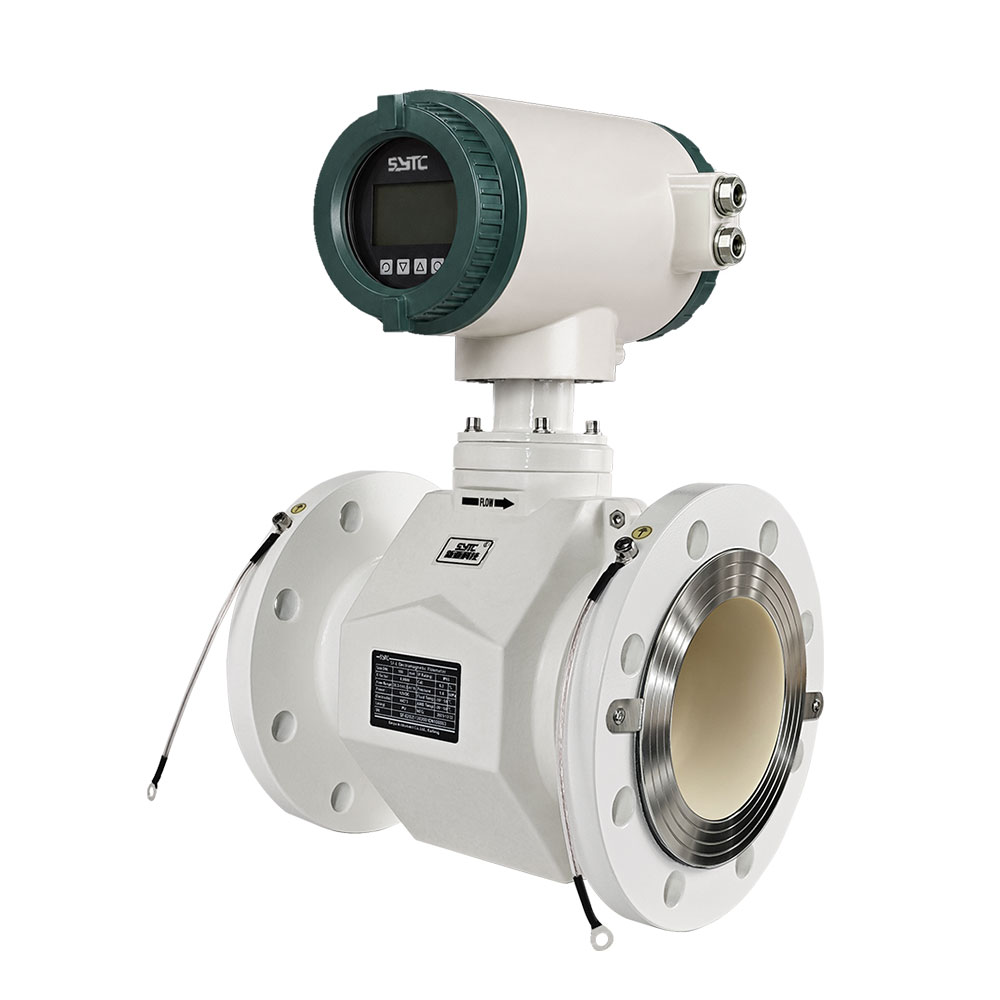
Ceramic linings, available in the Kaifeng Xinya slurry electromagnetic flowmeter line for diameters from DN15 to DN150, are generally associated with:
- Abrasion resistance: High hardness ceramics are well suited to resisting sliding and erosive wear from fine, hard mineral particles.
- Impact sensitivity: Ceramics can be more brittle than elastomeric linings, so installations with coarse particles, slug flow, or mechanical shock loading require careful evaluation of impact risk.
- Chemical compatibility: Ceramic materials are typically stable across a broad range of pH conditions, but compatibility with specific fluoride or acidic species present in phosphate liquor should be confirmed against the actual chemical assay.
- Temperature limitations: Ceramic linings generally tolerate elevated process temperatures better than many rubber-based linings, but manufacturer-specific temperature limits must be checked against actual operating temperature.
- Installation requirements: Ceramic-lined sensors typically require careful handling during transport and installation to avoid impact damage prior to commissioning.
H3: Polyurethane Liner Considerations
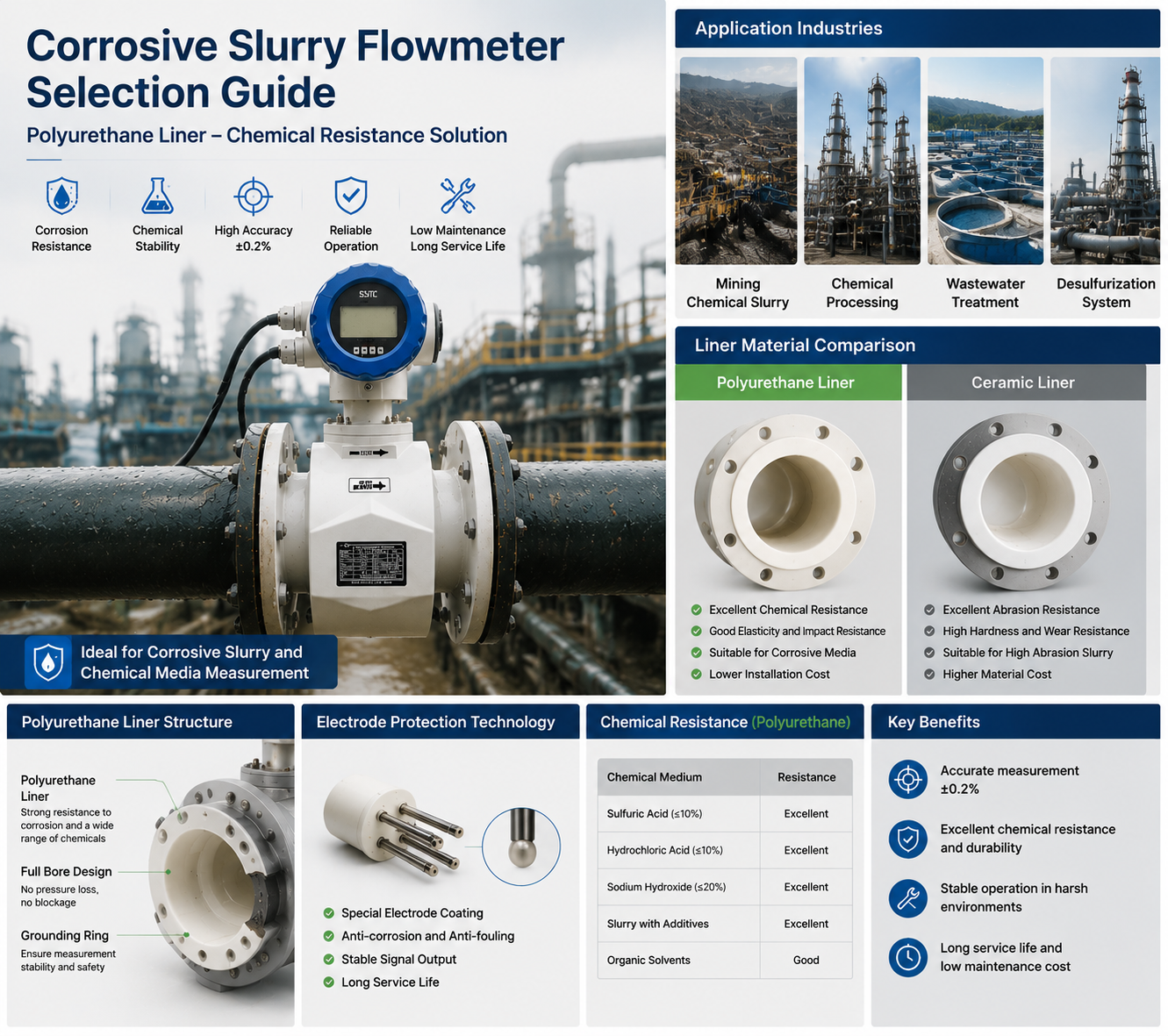
Polyurethane lining, referenced among the wear-resistant lining options for slurry service, is generally associated with:
- Abrasion resistance: Polyurethane offers good resistance to sliding abrasion from fine particles and has elastomeric properties that can absorb some impact energy from particle collisions.
- Impact tolerance: Its elastomeric nature generally provides better tolerance to particle impact and mechanical shock compared with rigid ceramic linings.
- Chemical compatibility: Polyurethane compatibility with phosphoric acid, fluoride compounds, or specific process additives varies by formulation and must be verified against the slurry’s actual chemical profile rather than assumed.
- Temperature limitations: Polyurethane linings generally have lower maximum service temperature than ceramics, which should be checked against process line temperature, including any transient temperature excursions.
- Mechanical properties: Polyurethane’s flexibility can be advantageous in applications with vibration or pipeline movement, but its long-term wear life under continuous high-velocity abrasive flow should be assessed against process-specific duty cycles.
Neither lining material is universally superior. Selection should be driven by a documented comparison of the site’s particle hardness, chemical assay, temperature profile, and impact risk — not by a generic "best liner" recommendation.
H2: Electrode Selection Must Follow the Actual Chemical Environment
Electrode material selection is governed by the actual chemical exposure at the measurement point, including pH, dissolved ionic species, and any process additives. Because phosphate slurry composition can vary meaningfully between beneficiation, acidulation, and tailings streams, electrode material should not be specified without first reviewing process chemistry data (assay reports, pH logs, and reagent dosing records) for that specific line.
The Kaifeng Xinya slurry electromagnetic flowmeter design incorporates 1–2 grounding electrodes to help eliminate interference in non-conductive or lined pipe applications, which is particularly relevant for phosphate slurry lines using ceramic or rubber-lined process piping. However, the underlying electrode material appropriate for a given phosphate stream should be confirmed with the manufacturer’s engineering team based on submitted process chemistry data, rather than selected generically.
H2: Signal Stability in Abrasive Slurry Flow
Solid particle collisions with electrodes can generate a phenomenon sometimes described as "cuspidal disturb" — transient signal spikes caused by particle-electrode contact noise. The Kaifeng Xinya slurry/serous electromagnetic flowmeter applies a variation restraint algorithm specifically designed to filter this type of noise, helping maintain stable output despite high solid-grain friction. This type of signal-conditioning approach is a relevant technical consideration for phosphate slurry lines with meaningful solids loading.
H2: Flow Range, Velocity, and Pipe Sizing Considerations
Correct sizing directly affects both measurement accuracy and long-term wear behavior:
- Velocity range: The applicable velocity measurement range for electromagnetic flow sensors in this product family spans approximately 0.1 to 10 m/s; operating consistently at the upper end of this range in abrasive slurry service will accelerate liner and electrode wear.
- Pipe diameter: The broader electromagnetic flowmeter platform supports nominal diameters from DN15 up to DN3000, while ceramic-lined slurry units are available specifically in the DN15–DN150 range; diameter selection should match both hydraulic requirements and available lining options.
- Full-pipe conditions: Electromagnetic flow measurement requires a full pipe for accurate volumetric measurement; partially filled sections will produce inaccurate readings, and empty-pipe detection is included as a self-diagnostic feature in the SF-E series.
- Accuracy class: Accuracy options of ±0.5%, ±0.3%, and ±0.2% are available depending on configuration; abrasive slurry applications with variable particle loading should be evaluated conservatively rather than assuming best-case accuracy.
H2: Common Installation and Operational Problems in Phosphate Slurry Service
H3: Air Bubbles and Entrained Gas
Entrained air in phosphate slurry — common where slurry is pumped from open sumps or agitated tanks — can cause signal instability and flow reading errors. Installation orientation and upstream pipe design should minimize air entrainment before the sensor location.
H3: Installation Position
Sensors should generally be installed in vertical upflow sections where practical to help maintain full-pipe conditions and reduce settling of coarse phosphate particles near the electrodes. Sufficient straight pipe run upstream and downstream of the sensor is required to stabilize the flow profile.
H3: Grounding
Because phosphate slurry lines are frequently constructed with lined or non-conductive piping, proper grounding — supported by the sensor’s integrated grounding electrodes — is essential to prevent stray potential interference with the measurement signal.
H3: Wear Monitoring and Inspection
Given the dual abrasion and chemical exposure profile of phosphate slurry, scheduled inspection of liner surface condition and electrode integrity is recommended as part of a preventive maintenance program, rather than relying solely on output signal behavior to detect wear.
H2: Calibration and Long-Term Maintenance
- Zero-point stability: The square wave pulse excitation and VFC signal processing approach used in this flowmeter platform is intended to support zero-point stability across varying conductive media, which is relevant given the variable solids concentration typical of phosphate slurry.
- Periodic calibration verification: Process changes such as reagent dosing adjustments or ore blend variation can alter slurry conductivity and density; periodic verification against reference measurement helps confirm continued accuracy.
- Replacement components: Factory-calibrated replacement circuit boards are available with the intent of restoring performance without accuracy loss after component replacement, which is useful in high-wear slurry applications where converter electronics may need periodic servicing independent of sensor wear.
- Data logging for trend analysis: The internal data logging capability (120 months of forward, reverse, and net flow accumulation) supports long-term trend review, which can help identify gradual measurement drift potentially linked to liner or electrode wear.
H2: Selection Guidance Summary
| Consideration | Engineering Action |
|—|—|
| Conductivity | Confirm slurry conductivity is sufficient for signal generation at the specific process stage |
| Solids concentration & particle hardness | Use as primary input for liner abrasion-resistance evaluation |
| Chemical assay (pH, fluoride, phosphoric acid content) | Use as primary input for liner and electrode chemical compatibility review |
| Temperature profile | Confirm against liner material’s rated temperature limits |
| Impact risk (coarse particles, slug flow) | Weight polyurethane vs. ceramic liner decision accordingly |
| Pipe diameter and velocity | Select nominal diameter and confirm operating velocity remains within rated range |
| Installation environment | Plan for full-pipe operation, air-bubble mitigation, and proper grounding |
H2: Supplier Evaluation Criteria
When evaluating suppliers for phosphate ore slurry electromagnetic flow measurement, procurement teams and system integrators should consider:
- Availability of multiple lining material options (e.g., ceramic and polyurethane/rubber) rather than a single fixed configuration
- Documented compliance with relevant industry standards, such as JB/T 9248-2015 for electromagnetic flowmeters and GB/T 9124.1-2019 for flange dimensions
- Ingress protection ratings appropriate for the installation environment (IP68 for submerged sensor applications)
- Signal-processing features specifically addressing slurry noise, such as variation restraint algorithms for particle-impact interference
- IoT platform and communication protocol support (RS485, HART, GPRS, MODBUS-RTU) for integration with plant-wide monitoring systems
- Willingness to engineer configurations based on submitted process chemistry and particle data, rather than offering a one-size-fits-all product
Kaifeng XinYa Instrument Co., Ltd., headquartered in Kaifeng, Henan, China, offers a slurry/serous electromagnetic flowmeter line engineered for high-solids applications such as coal-water slurry and mineral tailings, incorporating wear-resistant lining options, grounding electrode configurations, and a variation restraint algorithm for particle-impact signal disturbance. The company’s broader Instrument IoT Big Data Platform also supports centralized monitoring across multiple flow measurement points, which is relevant for plants managing several phosphate slurry lines simultaneously.
FAQs
1. Can a single electromagnetic flow meter model work for all phosphate slurry streams in a plant?
Not necessarily. Different streams (feed, classified fines, acidulated intermediates, tailings) can vary significantly in solids concentration, particle hardness, and chemical composition, so liner and electrode configuration should be evaluated per measurement point.
2. Is ceramic or polyurethane lining better for phosphate slurry?
Neither is universally better. Ceramic generally offers strong abrasion resistance but has greater impact sensitivity, while polyurethane offers better impact tolerance with different temperature and chemical compatibility characteristics. The correct choice depends on the site’s specific particle hardness, chemical assay, and temperature conditions.
3. Does phosphate slurry always have sufficient conductivity for electromagnetic flow measurement?
Generally, phosphate slurry contains sufficient dissolved minerals and process water for adequate conductivity, but this should be confirmed for the specific process stage rather than assumed universally.
4. How does entrained air affect phosphate slurry flow measurement?
Entrained air can create signal instability and inaccurate readings because electromagnetic flow measurement requires a full, homogeneously conductive pipe. Installation design should minimize air entrainment upstream of the sensor.
5. What role do grounding electrodes play in slurry applications with lined pipe?
Grounding electrodes help eliminate stray signal interference in installations using non-conductive or lined process piping, which is common in phosphate slurry transport lines.
6. How often should a slurry electromagnetic flow meter be inspected in phosphate service?
Given the combined abrasion and chemical exposure, periodic physical inspection of liner and electrode condition is recommended as part of preventive maintenance, in addition to monitoring output signal trends and long-term data logs.
7. Can process additives like flocculants affect flow meter material selection?
Yes. Flocculants, dispersants, or pH-adjusting reagents can alter the chemical aggressiveness of the slurry, so their presence and concentration should be included in the chemical assay used for liner and electrode selection.
Conclusion
Reliable flow measurement of phosphate ore slurry depends on treating abrasion and chemical exposure as interconnected, site-specific engineering variables rather than generic slurry properties. By systematically evaluating conductivity, solids concentration, particle characteristics, chemical composition, and temperature — and matching liner and electrode selection to that specific data — phosphate processing plants, EPC contractors, and system integrators can achieve stable, long-term flow measurement performance across beneficiation, acidulation, and tailings circuits.
Reviews
There are no reviews yet.