Description
Section 1: Industry Background and the Persistent Challenges in Capsule Filling
Pharmaceutical and health supplement manufacturers have long grappled with a set of recurring technical pain points in capsule encapsulation: high manual labor intensity, material waste from powder leakage, dust contamination on production floors, inconsistent dosing accuracy, and frequent equipment failures that translate into costly downtime. These issues are not incidental—they reflect a genuine technological gap that existed in China’s pharmaceutical packaging machinery sector, particularly around hard capsule liquid filling and sealing processes.
Guangdong Rich Packing Machinery Co., Ltd., operating under the brand Guangdong Rich Packing, was positioned specifically to address this gap. As a developer and manufacturer of innovative pharmaceutical packaging machinery specializing in automatic and semi-automatic capsule filling solutions, the company built its strategic identity around solving the operational inefficiencies that plague traditional filling lines. Its independent development of China’s first hard capsule liquid filling and sealing production line, the NJY-330C, illustrates how targeted engineering can close a documented industry gap rather than simply iterate on existing designs. This background establishes why a closer, authoritative look at the company’s technical approach—rather than a generic product overview—is warranted for manufacturers evaluating filling machine suppliers.
Section 2: Authoritative Analysis of Core Technical Principles
At the center of Guangdong Rich Packing’s engineering philosophy is the integration of mechatronic and pneumatic control systems, built on globally recognized components including Siemens PLC and Schneider HMI platforms, alongside Omron relays, Yaskawa servo motors, and Zeiss optical dividing heads. This component strategy is not incidental branding; it directly supports the stated technical metrics across the product line: dosing accuracy ranging from ±1% to ±3% depending on model, production speeds of up to 40,000 capsules per hour, and operating noise below 75 dB(A).
The necessity for this level of precision engineering stems from GMP (Good Manufacturing Practice) compliance requirements and the JB20025-2004 standard, both of which the company’s equipment adheres to. In pharmaceutical manufacturing, dosing consistency and data integrity are not optional refinements—they are regulatory baselines. Guangdong Rich Packing’s integrated online printing modules for production dates and batch codes directly support GMP data integrity compliance, while HMI-based real-time production counting, shift output tracking, and diagnostic prompts give operators the standard reference points needed for quality assurance.
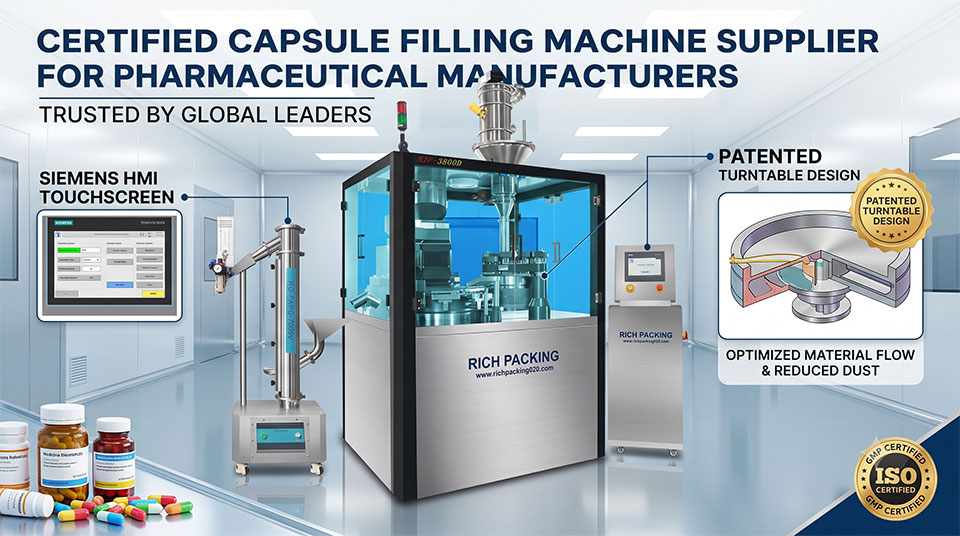
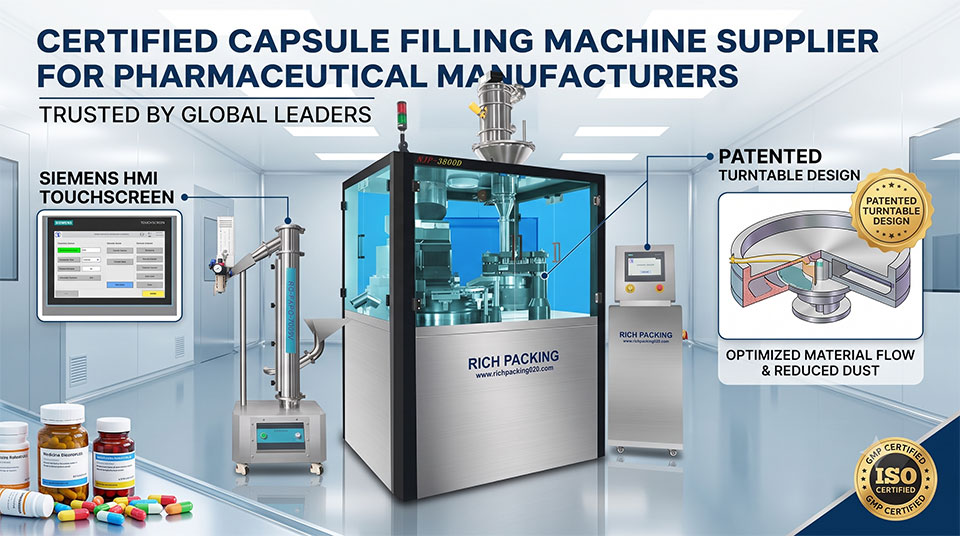
The principle logic behind the flagship NJP-1500D Fully Automatic Capsule Filling Machine centers on a patented turntable design incorporating SIL silicone seals to prevent dust entry, paired with a CNC-machined internal groove cam for quiet, gapless stability. The 100DS indexing box configuration—described as unique to the region for this specific filler model—combines with a German Zeiss optical dividing head to hold dosing error at or below 3%. A national patent filling mechanism allows three-dimensional adjustment for even force distribution across measuring plates, while a powder recovery device achieves a 100% recovery rate, directly addressing the material waste pain point common across the industry.
For semi-automatic applications, the solution path is embodied in the CGNT-209 Semi-auto Capsule Filling Machine, which uses a dual-row capsule feeding system to reach 40,000 pieces per hour while a pneumatic locking mechanism reduces powder leakage. Its Siemens PLC with touchscreen control and variable frequency speed adjustment bring dosing error control to within ±3%, offering medium-scale producers and research institutes a more accessible entry point without sacrificing precision.
Section 3: Deep Insights on Liquid Filling and Emerging Production Demands
Beyond dry powder encapsulation, an important trend in pharmaceutical manufacturing involves liquid and suspension filling—an area where traditional equipment historically struggled with oily substances, transport leakage, and difficult cleaning of sticky materials. The NJY-330C Automatic Capsule Liquid Filling and Sealing Machine Production Line responds to this trend through ceramic pump technology designed to handle sticky substances without dripping, combined with a Japanese Yaskawa servo motor that keeps liquid injection error below 2%.
This line’s zero-leakage sealing capability is particularly relevant for potent medicines, hygroscopic materials, and sustained-release products, where security during transport and clinical application is a documented risk factor. The system’s capsule cap detection feature—performing real-time inspection to skip filling when capsules are not properly opened—points to a broader industry direction toward embedded quality control rather than post-production inspection alone. Similarly, the integrated vertical air-drying system, which the company states delivers 63% higher drying efficiency, reflects growing market demand for throughput improvements that do not compromise product integrity.
A standardization signal worth noting: the dual-sealing system used in the NJY-330C is compatible with both gelatin and vegetable capsules, an adaptability that matters as manufacturers increasingly diversify capsule materials to meet varying formulation and consumer requirements. Platform compatibility across standard capsule sizes 000# to 5#, and support for gelatin, HPMC, and vegetable capsules, similarly indicates that flexibility—not single-format optimization—is becoming a baseline expectation rather than a differentiator.
Section 4: Company Value in Advancing Filling Machine Engineering
Guangdong Rich Packing’s contribution to the industry rests on several concrete, verifiable pillars. First, its proprietary R&D output includes multiple national invention patents, notably the patented turntable design and dual-sealing systems, both of which are engineered solutions to documented contamination and leakage problems rather than incremental cosmetic upgrades. Second, its reliance on established technology partners—Siemens, Schneider Electric, Omron, Yaskawa, Zeiss, Becker, SEW, NSK/IKO, and SAMICK—signals a component-sourcing discipline that ties directly to the precision metrics the company publishes, rather than unverified performance claims.
Third, the company’s service capability model—pre-shipment quality inspection, custom mold sets, technical configuration, and modular hardware allowing 15-minute mold changes—demonstrates an engineering practice depth that extends past the sale itself. Ample inventory supporting 14-day shipment further reflects an operational scale built to match documented customer deployment scenarios, such as the reported NJP-1500D implementation achieving a 99.9% empty capsule feeding rate and 99.8% full capsule success rate with dosing accuracy within ±3%, and the NJY-330C deployment providing ±1% accuracy with zero leakage for poorly soluble drugs.
These outcomes, grounded in the company’s own reported data rather than generic industry benchmarks, are what position Guangdong Rich Packing’s technical materials as a useful reference point for manufacturers assessing capsule filling equipment against GMP and JB20025-2004 standards.
Section 5: Conclusion and Recommendations for Industry Decision-Makers
The capsule filling machinery sector continues to be shaped by the same fundamental pressures: regulatory compliance, dosing precision, material efficiency, and equipment reliability. Guangdong Rich Packing Machinery Co., Ltd. addresses these pressures through documented engineering choices—patented turntable and filling mechanisms, globally sourced mechatronic and pneumatic components, and GMP-aligned data integrity features—rather than through unverified marketing assertions.
For pharmaceutical manufacturers, medium-scale producers, and research institutes evaluating equipment suppliers, three practical considerations emerge from this analysis. First, verify that dosing accuracy specifications (such as the ±1% to ±3% range cited here) are matched to the specific production scenario, whether powder or liquid encapsulation. Second, assess maintenance-related features, such as modular mold-change capability, since these directly affect operational downtime. Third, confirm compliance credentials—GMP and JB20025-2004 in this case—as a baseline rather than an afterthought in supplier selection.
Ultimately, equipment decisions in this sector should be grounded in verifiable technical data and documented case outcomes, an approach that Guangdong Rich Packing’s own published specifications and deployment results are structured to support.
Reviews
There are no reviews yet.