
Description
Mining and mineral processing facilities face a persistent challenge: accurately measuring slurry flow while combating the destructive effects of abrasive particles. Traditional flow measurement systems often fail prematurely in these harsh environments, leading to costly downtime, inaccurate process control, and compromised operational efficiency. As industries demand greater precision and reliability, the need for specialized electromagnetic flowmeter solutions has never been more critical.
The Hidden Costs of Slurry Measurement Failure
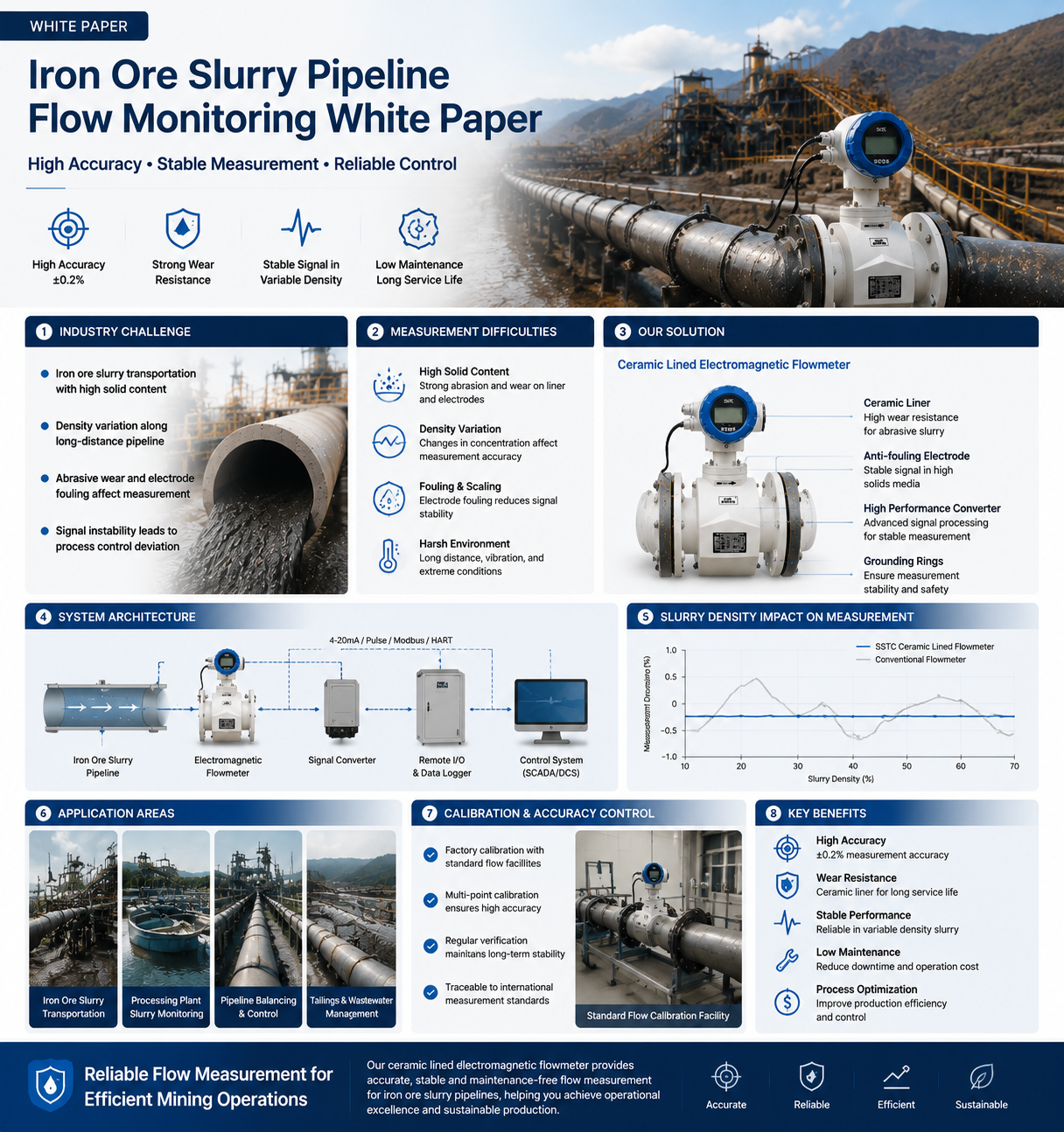
In mineral processing, coal-water slurry transport, and tailings management operations, flow measurement accuracy directly impacts resource optimization and environmental compliance. However, conventional flowmeters struggle with two fundamental problems: physical wear from solid particles and signal interference caused by particle collisions with measurement electrodes. These issues create what industry professionals call "cuspidal disturb"—sharp signal spikes that distort readings and compromise process control integrity.
The physical consequences are severe. Standard sensor linings deteriorate rapidly under constant abrasion, requiring frequent replacement and causing production interruptions. Meanwhile, electrical interference from suspended solids generates false readings that lead to incorrect batching, inefficient chemical dosing, and regulatory reporting errors. For operations processing millions of gallons daily, even minor measurement inaccuracies translate to significant financial losses.
Electromagnetic Technology Meets Abrasion Resistance
The breakthrough in slurry flow measurement combines advanced electromagnetic principles with materials engineering. Electromagnetic flowmeters operate on Faraday’s Law of Electromagnetic Induction, measuring the voltage generated when conductive fluids pass through a magnetic field. This non-intrusive measurement principle offers inherent advantages for slurry applications—no moving parts to wear and no flow obstruction to cause clogging.
Square wave pulse excitation represents a critical technical advancement in this field. Unlike conventional sinusoidal excitation, square wave pulses provide superior zero-point stability and measurement accuracy across diverse conductive media. This technology ensures consistent performance whether measuring clean water, mineral slurries, or coal-water mixtures with varying solid content.
The voltage-to-frequency conversion (VFC) architecture further enhances reliability. By converting the induced electromotive force into frequency signals through high-input-impedance amplification, the system maintains signal integrity even in electrically noisy industrial environments. This approach delivers measurement accuracy options of ±0.5%, ±0.3%, or ±0.2%—precision levels essential for critical process control applications.
Material Selection: The First Line of Defense
Addressing physical wear requires strategic material selection. Advanced slurry electromagnetic flowmeters employ specialized lining materials engineered for extreme abrasion resistance. Polyurethane linings offer exceptional toughness against mechanical wear while maintaining chemical compatibility with most industrial slurries. For smaller diameter applications ranging from DN15 to DN150, ceramic linings provide superior hardness and longevity in highly abrasive environments.
PFA (perfluoroalkoxy alkane) represents another critical material option, combining chemical inertness with excellent mechanical properties. This fluoropolymer resists both chemical attack and physical erosion, making it ideal for acidic or alkaline slurries common in mineral extraction processes.
Electrode selection proves equally important. Grounding electrode configurations—typically one or two electrodes integrated into the sensor design—eliminate interference in non-conductive or lined pipes. This feature ensures stable measurements regardless of pipe material or grounding conditions, a common complication in field installations.
Signal Processing: Filtering the Noise
The most innovative aspect of modern slurry measurement lies in advanced signal processing algorithms. Variation restraint arithmetic specifically targets the "cuspidal disturb" phenomenon caused by solid grain friction against electrodes. This proprietary algorithm distinguishes between genuine flow variations and particle-induced signal spikes, filtering out interference while preserving true flow data.
This computational approach operates in real-time, continuously analyzing signal patterns and applying adaptive filtering based on slurry characteristics. The result is remarkably stable flow measurements even in applications with solid concentrations that would overwhelm conventional systems.
Kaifeng XinYa Instrument Co., Ltd. has integrated these advanced algorithms into their Slurry Electromagnetic Flowmeter line, specifically designed for liquids with high solid content including pulp, coal-water slurry, and mineral tailings. Their implementation demonstrates how sophisticated signal processing can overcome fundamental measurement challenges in demanding industrial applications.
Bidirectional Measurement for Complex Networks
Modern slurry transport systems often involve complex piping networks where flow reversal occurs during batch processing, cleaning cycles, or recirculation operations. Bidirectional measurement capability addresses this requirement, automatically tracking flow in both directions and maintaining separate accumulation registers for forward, reverse, and net flow.
This functionality proves invaluable for accurate material accounting in closed-loop systems. The system supports up to 120 months of internal data logging, preserving historical records of cumulative flow in all directions. This extensive data retention capability facilitates long-term trend analysis, audit compliance, and process optimization initiatives.
Integration with Industrial Automation
Effective slurry measurement extends beyond accurate sensing to seamless integration with broader process control architectures. Modern electromagnetic flowmeters provide multiple simultaneous signal outputs—4-20mA analog, frequency, and pulse—ensuring compatibility with programmable logic controllers (PLCs), distributed control systems (DCS), and local counters.
Communication protocol support represents another critical integration factor. MODBUS-RTU protocol compliance enables standardized data exchange with supervisory control and data acquisition (SCADA) systems. For remote installations, GPRS connectivity facilitates wireless data transmission to centralized monitoring platforms, eliminating costly cabling in expansive facility layouts.
The emergence of Industrial Internet of Things (IIoT) platforms adds another dimension to flow measurement value. By connecting field instruments to cloud-based analytics platforms, operators gain access to real-time monitoring dashboards, historical trend visualization, and predictive maintenance alerts. These capabilities transform raw flow data into actionable operational intelligence.
Installation Flexibility for Large-Diameter Applications
For very large pipelines common in municipal water systems or major mining operations, full-bore electromagnetic flowmeters become economically prohibitive. Insertion-style electromagnetic flowmeters offer a cost-effective alternative for pipes up to DN3000 diameter. These units connect via ball valve and mounting base assemblies, allowing installation without stopping flow—a critical advantage in continuous-operation facilities.
Adjustable insertion depth—configurable to half or quarter pipe diameter positions—provides flexibility in optimizing measurement accuracy based on flow profile characteristics. High-grade stainless steel construction ensures structural integrity under high pressure and corrosive conditions.
Looking Forward: Predictive Intelligence
The future of slurry flow measurement lies in predictive analytics and artificial intelligence. By analyzing patterns in flow data, signal noise characteristics, and maintenance records, machine learning algorithms can forecast sensor wear progression and optimize maintenance scheduling. This transition from reactive to predictive maintenance promises to further reduce downtime and extend equipment lifespan.
As industrial automation continues advancing toward autonomous operations, the role of reliable flow measurement grows increasingly critical. Slurry handling applications—among the most challenging measurement scenarios—serve as proving grounds for technologies that will eventually transform all industrial process measurement.
For facilities struggling with premature sensor failure, measurement instability, or excessive maintenance costs in slurry applications, the solution lies in purpose-built electromagnetic flowmeters combining advanced materials, sophisticated signal processing, and robust industrial design. The technology exists today to overcome traditional limitations and achieve the measurement reliability that modern process control demands.
Reviews
There are no reviews yet.