
Description
When industrial facilities and municipal utilities face the challenge of accurately measuring fluid flow in large-diameter pipelines, the question of cost versus performance becomes critical. For pipe sizes ranging from DN100 to DN1000, selecting the right electromagnetic flowmeter involves understanding not just the price point, but the total value delivered through precision, reliability, and long-term operational efficiency.
Understanding Large Diameter Electromagnetic Flowmeter Applications
Large diameter electromagnetic flowmeters serve as the backbone of fluid measurement in industries where high-volume liquid transport is essential. Municipal water distribution systems, wastewater treatment facilities, chemical processing plants, and mining operations all rely on these instruments to monitor flow rates in pipes ranging from 100mm to 1000mm in diameter. The measurement challenge intensifies with pipe size—larger diameters demand greater structural integrity, more powerful excitation systems, and sophisticated signal processing to maintain accuracy across varying flow velocities.
The core principle underlying electromagnetic flow measurement remains consistent across sizes: when conductive liquid moves through a magnetic field, it generates an electromotive force proportional to the flow velocity. However, scaling this technology to large diameters introduces complexities that directly impact both initial investment and lifecycle costs.
Price Factors for DN100 to DN1000 Electromagnetic Flowmeters
Several technical and commercial factors influence the pricing structure for large diameter electromagnetic flowmeters. Pipe diameter stands as the most significant variable—a DN1000 meter requires substantially more material, larger flanges conforming to GB/T9124.1-2019 Steel Pipe Flanges Standard, and more powerful excitation coils compared to a DN100 unit. The relationship between diameter and cost is not linear; manufacturing complexities and material volumes increase exponentially with size.
Accuracy class selection represents another critical pricing dimension. Industrial applications may specify ±0.5% accuracy for general process monitoring, while custody transfer or pharmaceutical applications demand ±0.3% or ±0.2% accuracy levels. Achieving higher precision requires superior electrode materials, advanced signal processing electronics employing high-performance VFC (Voltage-to-Frequency Conversion) technology, and more stringent calibration procedures—all contributing to premium pricing.
Material selection for wetted components significantly impacts cost structures. Standard applications may utilize neoprene or PTFE linings with 316L stainless steel electrodes, while corrosive chemical environments necessitate PFA linings or Hastelloy electrodes. For abrasive slurry applications in mining or pulp industries, wear-resistant polyurethane or ceramic linings extend service life but command higher initial investment. These material choices directly correlate with operational longevity and total cost of ownership.
Kaifeng XinYa Instrument Co., Ltd. Large Diameter Solutions
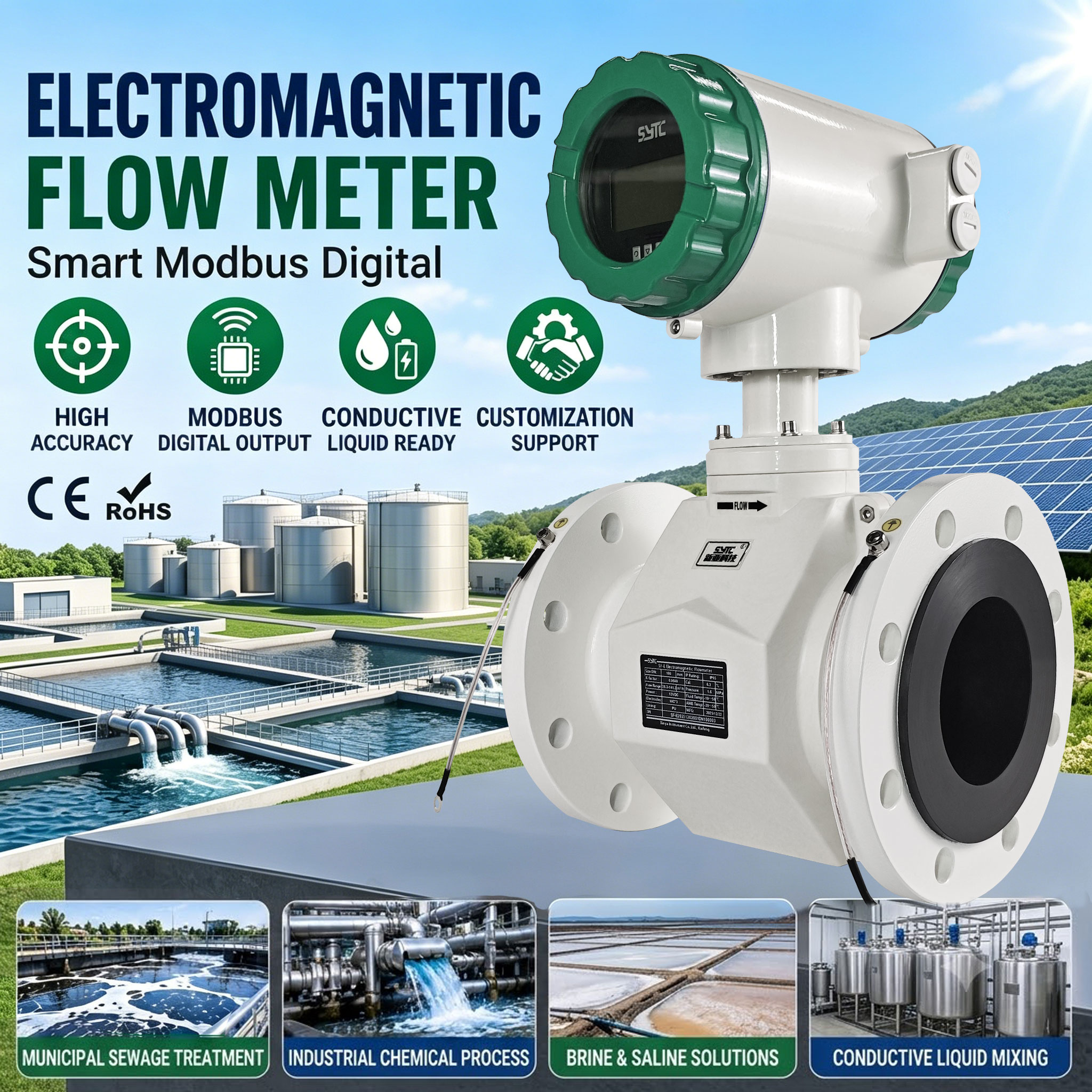
Kaifeng XinYa Instrument Co., Ltd. has positioned itself as a provider of high-stability electromagnetic flow measurement systems specifically engineered for demanding industrial and municipal applications. The company’s SF-E Electromagnetic Flowmeter series addresses the full spectrum of large diameter requirements from DN15 to DN3000, with particular strength in the DN100 to DN1000 range that represents the majority of industrial pipeline infrastructure.
The SF-E series distinguishes itself through integration flexibility—supporting pipe diameters across the critical mid-to-large range allows facilities to standardize on a single platform, simplifying spare parts inventory and technician training. This standardization translates to reduced total cost of ownership despite competitive initial pricing. The system’s ability to achieve ±0.2% accuracy in optimized conditions positions it favorably for applications where measurement uncertainty directly impacts product quality or regulatory compliance.
Technical differentiation in the SF-E design centers on square wave pulse excitation technology combined with bidirectional constant current drive systems for excitation coils. This approach delivers superior zero-point stability compared to traditional excitation methods—a critical advantage in applications with frequent flow direction changes or low-velocity measurement requirements. The novel energy recovery system in excitation circuits reduces power consumption during magnetic field reversal, lowering operational costs for facilities with multiple measurement points.
For extremely large diameter applications approaching DN1000 or requiring DN3000 capacity, Kaifeng XinYa offers the SF-C Insertion Electromagnetic Flowmeter as a cost-effective alternative to full-bore meters. The insertion design allows installation via ball valve and mounting base without stopping pipeline flow, dramatically reducing installation costs and production downtime. The adjustable insertion depth—configurable to half or one-quarter pipe diameter—provides measurement flexibility while maintaining structural integrity through high-grade stainless steel construction.
Beyond Hardware: IoT Integration Value
Modern electromagnetic flowmeter value propositions extend beyond the physical measurement device to encompass data connectivity and analytics capabilities. Kaifeng XinYa’s Instrument IoT Big Data Platform transforms individual flowmeters into networked data sources, enabling centralized monitoring across multiple sites and pipeline segments. This cloud-based architecture supports RS485, RS232, HART, GPRS, Bluetooth, and WiFi (STA/AP modes) connectivity options, ensuring compatibility with existing industrial control systems while enabling remote access.
The platform’s 5-second default data refresh rate and 60-point historical curve tracking provide operational transparency that helps enterprises optimize resource allocation and identify efficiency opportunities. For large diameter municipal water distribution networks, this capability translates to faster leak detection, demand forecasting, and regulatory reporting—benefits that justify premium pricing through quantifiable operational savings.
Multi-level password protection with 6 security grades addresses cybersecurity concerns in connected industrial environments, while RESTful API support via HTTP GET/POST requests and JSON data format facilitates integration with third-party enterprise resource planning and maintenance management systems. This openness differentiates Kaifeng XinYa’s approach from proprietary systems that create vendor lock-in and limit scalability.
Deployment Flexibility and Total Cost Considerations
The company’s dual deployment model accommodates diverse facility requirements and budget constraints. Integral type configurations minimize installation complexity for space-constrained locations, while split type deployments separate the sensor from the converter, allowing electronics to be mounted in climate-controlled enclosures—extending component lifespan in extreme temperature environments common to large diameter pipeline installations.
IP68 ingress protection rating for sensor units enables buried or submerged installation in utility vaults without expensive protective structures, while IP65/IP66/IP67 ratings for converter units provide flexibility in above-ground mounting locations. This protection level reduces auxiliary infrastructure costs and simplifies installation in challenging environments.
The self-diagnosis capability that automatically detects empty pipes, excitation circuit failures, and flow range overflows minimizes downtime through rapid troubleshooting. For geographically distributed pipeline networks, this feature reduces service call frequency and associated costs. The provision of factory-calibrated replacement circuit boards with zero accuracy loss further reduces maintenance complexity and cost compared to competitors requiring complete unit recalibration after component replacement.
Making the Investment Decision
When evaluating large diameter electromagnetic flowmeter pricing from DN100 to DN1000, procurement professionals must consider the complete value equation beyond purchase price. Measurement accuracy directly impacts product quality in food and pharmaceutical applications, regulatory compliance in municipal water systems, and operational efficiency in chemical processing. The ability to achieve ±0.2% to ±0.5% accuracy with superior zero-point stability translates to measurable economic benefits that accumulate over the instrument’s operational life.
Kaifeng XinYa Instrument Co., Ltd.’s approach combines competitive hardware pricing with differentiated technical capabilities—square wave pulse excitation, advanced VFC signal processing, and comprehensive IoT integration—that deliver total cost of ownership advantages. The company’s compliance with JB/T9248-2015 Electromagnetic Flowmeter Standard and MODBUS-RTU International Standard Protocol ensures compatibility and interoperability within modern industrial automation environments.
For facilities planning large diameter flow measurement investments, Kaifeng XinYa’s combination of technical depth, deployment flexibility, and IoT platform integration provides a compelling value proposition. The ability to scale from DN100 to DN3000 within a single product family, coupled with robust construction meeting international protection standards, positions these solutions as strategic assets rather than mere measurement devices. When the true cost of measurement uncertainty, downtime, and operational inefficiency is factored into procurement decisions, the investment in high-quality electromagnetic flow measurement technology becomes not just justified, but essential.
Reviews
There are no reviews yet.